Culture and Society
 PUBLISHED


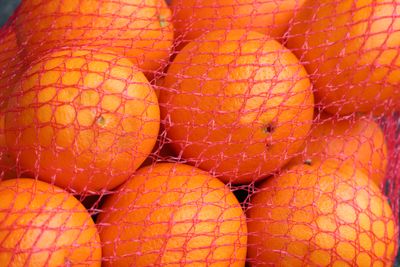


Have you ever wondered why oranges are often sold in those strange red net bags? It’s a sneaky trick used by food producers and supermarkets to fool your senses and (hopefully) make you buy more fruit.
A red or orange net wrapped around the fruit makes the peel appear a richer, deeper orange, giving it a juicier, more appealing look. Even if the fruit is still slightly unripe, the colored net masks the green tones and exaggerates the orange ones, making it look riper than it actually is.
Similarly, lemons are often put in yellow net bags to enhance their natural color. If they were put in red bags, they’d look orangey and not as conventionally appealing.
The Confetti Illusion
The principle is based on the confetti illusion, a visual phenomenon where the perception of colors is strongly influenced by its surrounding context. In this optical illusion, a neutrally colored ball is placed within a grid of differently colored lines. When the lines of a particular color are in the foreground, the ball's color appears to blend with that of the lines.
In a 2024 study, psychologist Karl R. Gegenfurtner from Giessen University in Germany detailed how the supermarket’s orange bag utilizes the confetti illusion.
“I buy juice oranges from my favorite fruit seller Helga every Saturday at the local market. On a recent day, she did not have any nice ripe oranges, as could be expected during the German summer," he wrote.
"Later, stopping by in a supermarket, there seemed to be an abundance of ripe oranges, and of course, I bought a bunch of them, handily packaged into an orange net for carrying.”
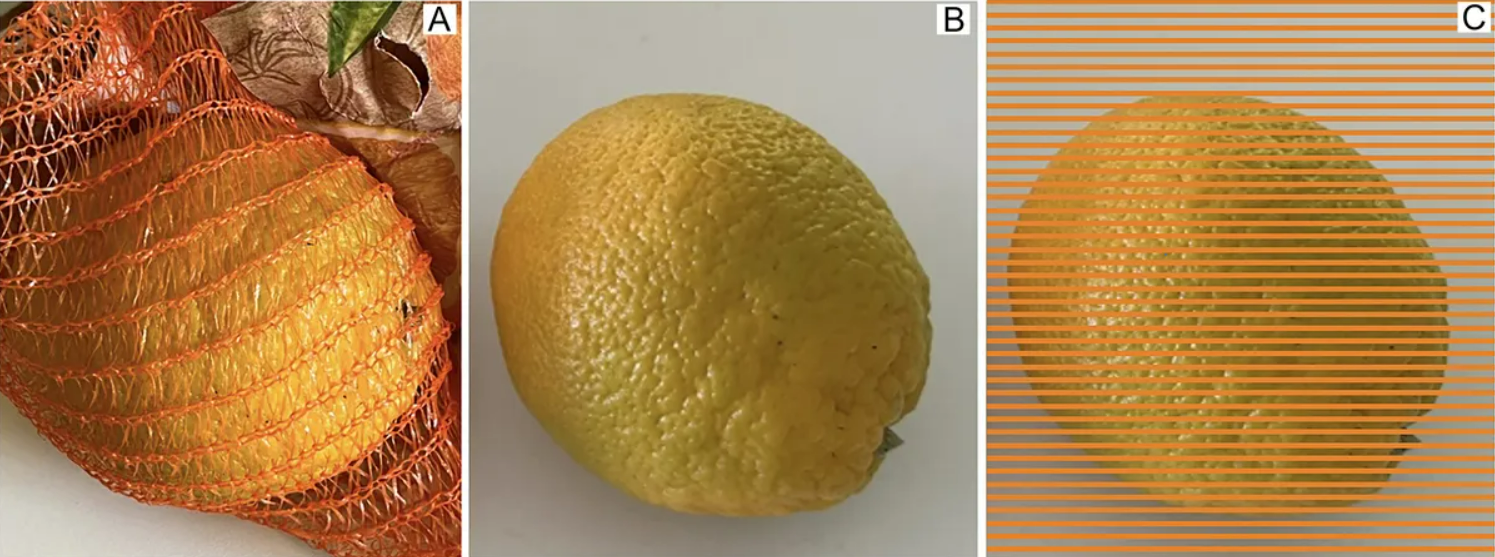
“At home, when I took out the oranges from the net, a miracle happened: each orange, beautifully colored within the net, turned into an abysmal shade of green!” Gegenfurtner continues.
Staying true to the scientific method, he also put forward evidence to verify his claim, in the form of photographs showing some deceitful oranges.
“We conclude that color assimilation alone provides a strong effect on color appearance, turning the greenish-looking orange into a beautifully orange one. Needless to say that fruit vendors have realized this a long time ago,” the study concludes.
"Looking around in typical supermarkets, it is easy to see that fruits and vegetables (e.g., lemons, onions, zucchini, or even potatoes) are typically packaged in nets that are of the color of perfect exemplars," it added.
The paper explains that the confetti illusion is based on the principle that our brains are programmed to process peripheral vision and color perception.
In essence, our brains aim to provide us with a smooth, seamless experience that can be understood as effectively as possible. Likewise, our visual system is wired to perceive uniformity and smooth transitions. When the red netting is placed over an orange, our brains merge adjacent colors to simplify what we see.
Whether or not this trick of deception actually increases the sales of oranges is not known, although we would encourage researchers to take on the task.
An earlier version of this article was published in August 2024.