Space and Physics
 PUBLISHED
 14
14



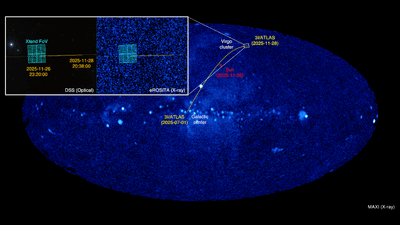


The emission of X-rays is usually the domain of the energetic events of the universe: hot stars, supermassive black holes, and the like. However, since 1996, with Comet Hyakutake, we have learned that even comets can emit X-rays. But despite efforts, no such signal was ever seen for an interstellar object. Enter this year’s superstar Comet 3I/ATLAS, breaking yet another record.
Interstellar object 3I/ATLAS is different from its predecessors, 1I/’Oumuamua, discovered in 2017, and Comet 2I/Borisov in 2019. It’s faster, it’s older, more active, and estimated to be larger. Now, observations from the X-ray telescope XRISM suggest that it is also the first interstellar object with an X-ray signature.
Before the conspiracy theorists claim that this is some sort of engine signature or a weapon charging up, let’s stress that it is perfectly normal for comets to emit X-rays. This emission comes from specific interactions between the plasma released at high speed by the Sun and the coma, the atmosphere of the comet. This is gas and dust released as the comet gets near the Sun.
The plasma slams into the gas of the coma, and it can rip electrons from the gas’s atoms. The electrons are pushed away with such energy that they begin to emit X-rays. It doesn’t matter that comets are among the coldest objects in the universe. This plasma interaction produces electrons with a temperature of millions of degrees.
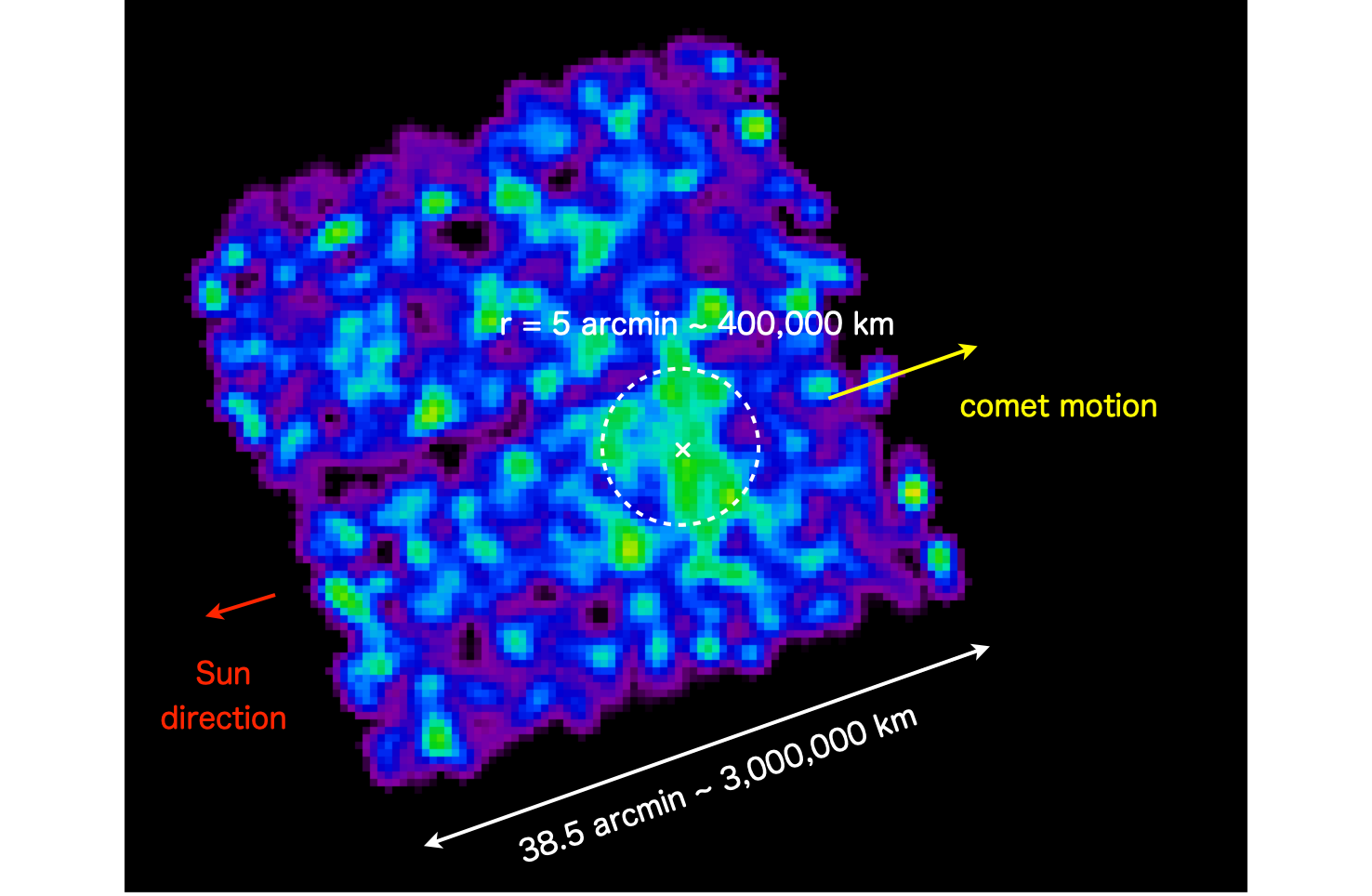
The data was collected from 23:20 on November 26 to 20:38 on November 28, 2025, with an effective exposure of 17 hours. The primary analysis is consistent with a faint X-ray glow spanning 400,000 kilometers (250,000 miles). The team believes that it would be difficult to explain this signal just with noise from the detector.
While more work is necessary, the team has other preliminary evidence. The X-ray signatures of carbon, nitrogen, and oxygen appeared in the data in a way that couldn't happen if there was a different source, such as the galaxy at large or even from our own atmosphere.
You might wonder, if looking for an X-ray emission was so important, why did it take so long for astronomers to search for it? Comet 3I/ATLAS was discovered on July 1, after all. The problem was its position in the sky. For most of the last several months, it appeared too close in the sky to the Sun for X-ray observatories to safely observe it. The researchers scheduled the observations for a moment when it appeared far enough away from the Sun to do it safely.
Other X-ray observatories can now safely observe it, so we might be getting further X-ray insights in the coming weeks, as we approach the closest distance between the comet and Earth.