Space and Physics
 PUBLISHED
 3
3



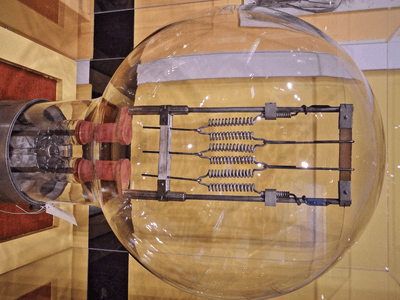


A team of scientists has replicated one of Thomas Edison's early experiments from his quest to make the lightbulb, but with the aim of making graphene, rather than light. They succeeded, and they think Edison may also have made the wonder material, though he lacked the capacity to recognize its remarkable attributes at the time.
Although Edison is now widely seen as the villain in his battle with former employee Nikola Tesla over which type of current to use for the US national grid – in no small part due to his approach to intellectual property – he was once a major hero.
Others had made incandescent lights before Edison, but the lifespan of these early attempts was too short or the current too high to compete with gas or oil.
Edison's (or, perhaps more accurately, his staff’s) experiments with a vast range of filaments and methods to remove soot became the stuff of legend, exemplified in his quote: "I have gotten a lot of results! I know several thousand things that won’t work."
Much more recently, Lucas Eddy was on a similar quest as a graduate student at Rice University. “I was developing ways to mass produce graphene with readily available and affordable materials,” he said in a statement.
Graphene, a two-dimensional form of hexagonally arranged carbon, is already used in quantum physics experiments and is anticipated to have applications in supercomputing and energy storage. Work showing its electrical capabilities won the 2010 Nobel Prize for Physics.
Turbostatic graphene, one of its several forms, is currently made by putting a voltage across a carbon-based resistor, and requires heating to at least 2,000°C (3,600°F). Eddy hoped to find a cheaper option than current mechanisms for doing this, which are quite elaborate.
“I was looking at everything from arc welders, which were more efficient than anything I’d ever built, to lightning struck trees, which were complete dead ends,” he said. “I was trying to figure out the smallest, easiest piece of equipment you could use for flash Joule heating, and I remembered that early light bulbs often used carbon-based filaments.”
A labmate called it Eddy’s lightbulb moment, and as the symbol from cartoons usually indicates, it provided his solution. Edison’s original lightbulbs worked by heating the filament to 2,300°C so that it glowed, and his patent applications described the process in detail.
Edison’s carbon filaments were subsequently replaced with tungsten, and when Eddy tried to buy an original, purveyors tried to sell him the metal version. “But I finally found a small art store in New York City selling artisan Edison-style light bulbs,” he said. Hooray for hipsters! The bulbs even used Japanese bamboo for the filament, as Edison did.
By leaving the light on for just 20 seconds at a time, Eddy was able to change the filament’s color from gray to silver. If Edison had been curious about such a transformation, he would have struggled to understand the product. However, with the help of Raman spectroscopy, invented around the time Edison died, Eddy identified the substance involved, showing that parts of the filament were now graphene.
Eddy and his co-authors suggest Edison-style light bulbs could be used to more easily study the way graphene is produced under steady voltages, and how defects form in it.
Edison didn’t keep his experimental lightbulbs for posterity, but he did record that his first test ran for 13 hours. Over that time, any carbon initially converted to graphene would almost certainly have been turned into graphite. Even if Edison had known what to look for and how to test for it, he would only have found graphene if he stopped the experiment early.
Nevertheless, Professor James Tour, in whose lab Eddy worked, said: “To reproduce what Thomas Edison did, with the tools and knowledge we have now, is very exciting. Finding that he could have produced graphene inspires curiosity about what other information lies buried in historical experiments. What questions would our scientific forefathers ask if they could join us in the lab today? What questions can we answer when we revisit their work through a modern lens?”
The study is published in ACS Nano.