


 Health and Medicine
 PUBLISHED





What you’ll discover in this article
- A new vaccine platform called PROTEXI seeks to turn the immune system’s memory of COVID-19 against a new foe: cancer cells.
- “This is something that has never really been achievable with cancer vaccines before,” study author Dr John Letterio told IFLScience.
- The platform uses a patient’s own cells and trains them to recognize a tumor, while simultaneously activating the pre-existing immune response that’s been built by COVID vaccination or infection.
- The first human trials in sarcoma, cancer of the connective tissue, are currently being planned.
If you were vaccinated against COVID-19, your immune system remembers the virus. The whole point of vaccines is that this memory gives your body a head start at fighting an infection the next time you come into contact with it. But, a new study asks, why stop there?
The scientists behind a new vaccine platform want to take that prior immunity and use it to tackle an entirely different disease: cancer. Their platform is called PROTEXI.
“Killers” and “commanders”
“The idea was born out of a problem that has frustrated cancer vaccine researchers for decades,” Dr John Letterio at University Hospitals Rainbow Babies & Children’s Hospital in Ohio told IFLScience.
“Our immune system has two main types of soldiers in the fight against cancer: CD8 'killer' T cells, which directly destroy tumors, and CD4 'helper' T cells, which act like commanders that tell the killers where to go and keep them energized for the fight.”
Other cancer vaccines in the works, said Letterio, bypass the commanders and go straight for the killers. That often means the killers can’t respond as strongly, but it’s a necessary trade-off because identifying cancer-specific commanders is difficult and expensive.
“Then it dawned on us: what if we didn't need to find new commanders at all? What if we could use commanders that are already on standby in almost every person on the planet, specifically, the immune memory left behind by COVID-19 vaccination or infection?”
Something that has “never really been achievable” before
Most people who have lived through this pandemic have been exposed to SARS-CoV-2 in some way, whether that’s through vaccination or actually catching the virus.
Both routes lead to the generation of immune memory. Letterio and his team told IFLScience they believe their cancer vaccine can capitalize on either type of immunity.
The massive investment in understanding the COVID spike protein and the immunity it generates has given us a tool we can now redirect for a completely different purpose
John Letterio
“The COVID spike protein fragments we use in PROTEXI are recognized by CD4 helper T cells regardless of whether a person built that immunity through vaccination or through surviving a natural infection. What matters is that the memory T cells exist and are functional, which they are in both cases.”
“Given that the vast majority of the global population has now been exposed to the spike protein either through vaccination or infection, this means PROTEXI has the potential to work for an extraordinarily broad population of cancer patients.”
“This is something that has never really been achievable with cancer vaccines before.”
“A coordinated, supercharged immune attack”
To come back to the military analogy, PROTEXI makes use of each patient’s own internal immunity bootcamp.
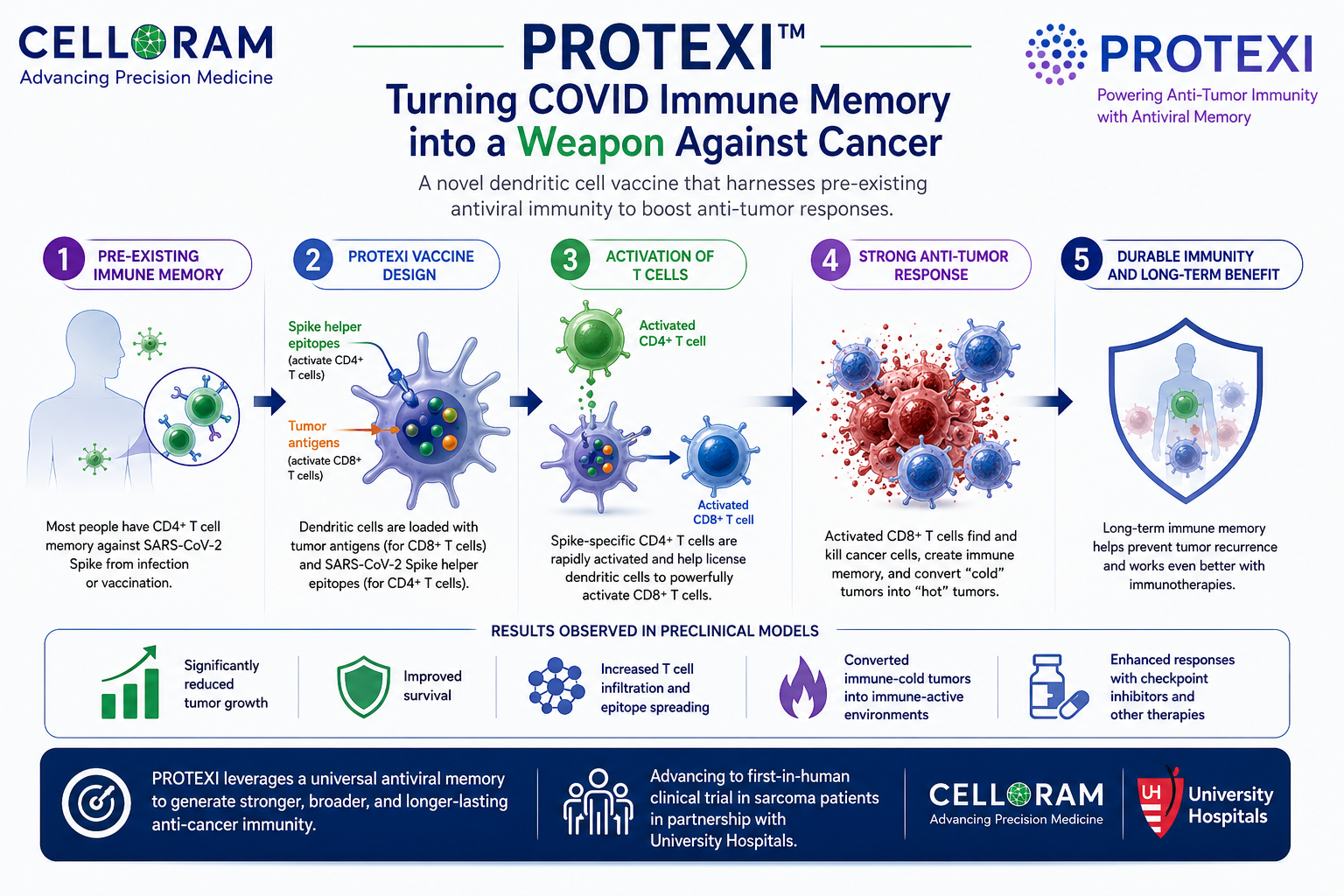
“We use a patient's own dendritic cells, which are a type of immune cell that teaches your immune system what to fight; it is a type of immune 'training cell'. We expand those dendritic cells in the lab and load them with two things at once: fragments of tumor proteins to teach the killers what to hunt, and fragments of the COVID spike protein to summon the ready-made commanders,” Letterio said.
“The result is a coordinated, supercharged immune attack on the tumor.”
This mechanism is quite different from other cancer vaccines already at various stages of development.
mRNA vaccines, for example, take the same technology used to create those COVID vaccines many of us received and pivot it towards fighting cancer.
“There is a lot of interest in mRNA cancer vaccines, like those being developed by BioNTech and Moderna, which represented a real scientific leap forward,” said Letterio.
These vaccines carry transient genetic “instructions” in the form of mRNA that teach the body’s cells to produce proteins the immune system can respond to. This approach offers the promise of personalized medicine, because a patient’s specific tumor can be genetically sequenced and inform the design of an ideal vaccine for their particular cancer.
The moment that genuinely stopped us in our tracks was when we saw the epitope spreading data.
John Letterio
Letterio said PROTEXI is also highly personalized because it uses the patient’s own cells as “living delivery vehicles.”
“We take a patient's own immune cells from their blood, train them in the lab with both the tumor targets and the COVID helper signals and then put them back into the patient. The dendritic cell itself carries both messages and presents them together to the immune system, which is critical for coordinating the response.”
And there’s another potential advantage, called the “epitope spreading effect.”
“Once PROTEXI gets the immune response going, we see the immune system start spontaneously recognizing other parts of the tumor that weren't even in the vaccine. […] This is enormously valuable because tumors are notoriously good at hiding.”
“The moment that genuinely stopped us in our tracks was when we saw the epitope spreading data,” Letterio added.
“We had vaccinated mice against specific tumor targets, essentially teaching the immune system to recognize two or three specific 'wanted posters' for the tumor. But then, when we looked at what the immune system was actually attacking, we found it had spontaneously expanded to recognize tumor proteins we never included in the vaccine.”
“It's the immune equivalent of a detective solving one crime and using the evidence to crack several more.”
“The vaccine had essentially trained a standing army”
In their new study, Letterio and his colleagues demonstrate PROTEXI in a number of preclinical experiments and in a humanized mouse model, which takes mice that have had their own immune systems genetically engineered away and replaces them with human immune cells.
In mouse melanoma and breast cancer models, PROTEXI reduced tumor growth and improved survival. The team demonstrated that harnessing the pre-existing viral immunity worked more effectively than a dendritic cell-only vaccine alternative.
They also found that the protective effect was long-lasting.
“Mice that had their tumors controlled by PROTEXI were re-challenged with fresh tumor cells weeks later, and they rejected those too, and did so without any additional treatment. Their immune systems had built lasting memory,” Letterio explained.
“When we transferred immune cells from those surviving mice into new, naive mice, those mice also resisted tumor growth. The vaccine had essentially trained a standing army that remained on guard long-term.”
What’s next on the horizon?
COVID makes sense as a first step for this tech – as we’ve seen, nearly everyone who might benefit from PROTEXI is likely to have pre-existing COVID immunity.
“The massive investment in understanding the COVID spike protein and the immunity it generates has given us a tool we can now redirect for a completely different purpose. That's an extraordinary scientific silver lining,” Letterio said.
That’s not to say, however, that scientists couldn’t also try this with other common human pathogens. This, Letterio told IFLScience, “is one of the most exciting longer-term horizons of this work.”
“Future iterations could potentially explore, Epstein-Barr virus (EBV, which causes mono and infects over 90 percent of adults), cytomegalovirus (CMV), or even common influenza strains.”
The team at University Hospitals, in collaboration with Celloram, Inc. who developed the vaccine technology, is now planning a first-in-human clinical trial focusing on sarcoma. This type of cancer is known as “immune cold,” meaning that the immune system essentially ignores it, so it’s very difficult to treat with immunotherapies.
“[I]f PROTEXI can turn a cold tumor hot, it proves the concept in one of the hardest possible settings,” said Letterio. “[The trial] will tell us whether the promise we've seen in the laboratory translates to real benefit for real patients.”
He added that “for anyone whose life has been touched by cancer – particularly young people with sarcoma – we want you to know that this work is driven by that reality every day.”
“The patients are the reason we do this, and our goal is to get this therapy to the people who need it as quickly and safely as science allows.”
The study is published in Nature Communications.



 1
1