Health and Medicine
 PUBLISHED
 1
1





Pockets of the US have worryingly low uptake of the MMR vaccine and it’s leaving populations vulnerable to disease. New modeling has mapped county-level MMR coverage across the nation and revealed “substantial clusters of undervaccination” – including in areas that recently went through measles outbreaks.
The MMR vaccine protects against three diseases: measles, mumps, and rubella. The combined vaccine was first approved in the US in 1971, so after all these decades it’s easy to forget what a scourge these diseases used to be. Measles, in particular, can cause long-term health problems and even death – either from the initial infection, or years down the line thanks to a terrifying complication known as SSPE.
Keeping vaccine coverage at a high level is vital to stop outbreaks of these diseases popping up and spreading out of control, so it’s important that health authorities have a good handle on where there are areas of vulnerability.
The team of investigators, from the Icahn School of Medicine at Mount Sinai and Boston Children’s Hospital, collected a nationally representative sample of data from over 22,000 parents of kids under 5.
They used OutbreaksNearMe, an online survey platform that’s used by millions of people to log symptoms in order to help track COVID and flu outbreaks. Other researchers have leveraged this platform in the past to ask users about MMR vaccination status.
They combined this with other statistical and AI-based methods to reach their estimates of vaccine coverage at county level across the contiguous United States. Their approach, they explain, captures kids who may not be included in official reports, such as those who are homeschooled or don’t have health insurance.
At a national level, they estimated that approximately 71.1 percent of eligible children (those aged over 6 months) had received at least one dose of MMR. But when you start to dig down into the local data – which you can via the authors’ interactive website – you see that the picture across the country is far from balanced.
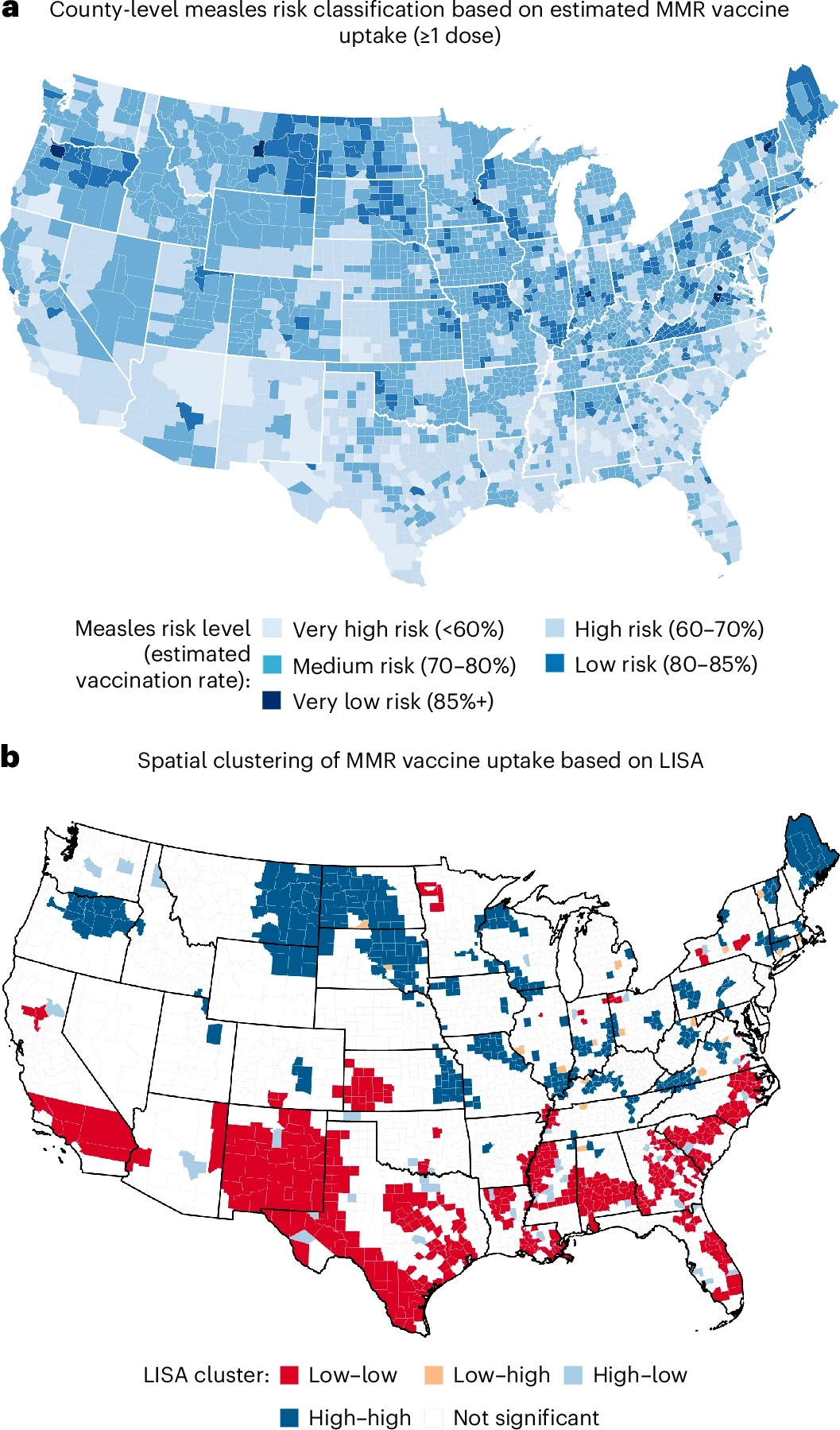
The state with the lowest coverage, aggregated across counties, was New Mexico, coming out at 61.1 percent. At the other end of the scale was Massachusetts at 71.3 percent. The individual counties with the lowest coverage were mostly found in Georgia, Texas, and Mississippi, while those with the highest appeared in New York, Indiana, and Oregon.
Notably, the authors compared their data with official figures from the Centers for Disease Control and Prevention (CDC) and found two particularly stark discrepancies. For Texas, the authors reached a figure of 62.9 percent coverage, much lower than the CDC’s 93.7 percent. For New Mexico, it was a similar story: 61.6 percent versus the CDC’s 90.3 percent.
Both of these states were dealing with major measles outbreaks in 2025 when the analysis was done.
The maps also show regions where counties with low vaccination uptake are clustered together. These regions, in places like West Texas and the rural southeast of the country, are vulnerable to future disease outbreaks.
“These findings underscore the urgent need for surveillance systems to include more granular and timely data that accurately identify undervaccinated communities, enabling targeted, timely public health interventions,” the authors write.
There are limitations to the approach, however, which the authors address in their paper. One that could account for some of the differences between their figures and official data is that they relied on parents' recollections of whether their kids were vaccinated. They also had low response levels from some counties and included very young children who may have received the vaccine later.
Fast-forward to the current situation, and there’s an escalating measles outbreak in South Carolina that reportedly just surpassed 600 cases. Officials are on a deadline to gather measles transmission data for a meeting with the Pan American Health Organization set for April this year, where a decision will be taken on whether the US and Mexico have lost their official measles elimination status – as happened to Canada last year.
The MMR vaccine, perhaps more than any other, has found itself in the crosshairs of anti-vaccine conspiracists in recent times. The spread of misinformation – including directly from Health and Human Services Secretary Robert F. Kennedy, Jr. – contributes to mistrust and hesitancy, all of which is fueling the resurgence of measles.
“Measles anywhere is a threat everywhere,” commented Professor Scott Weaver in a recent statement from the Global Virus Network, a coalition of virologists from over 40 countries. “These outbreaks are the result of long-standing global challenges in maintaining high childhood vaccination coverage and persistent vulnerabilities in public health systems.”
“Strengthening routine immunization, surveillance, and public education is essential to prevent further outbreaks,” added Professor Heidi Larson, founding director of the Vaccine Confidence Project.
This new work feeds into these goals by providing what the authors call an “innovative resource for improving immunization strategies and mitigating measles outbreaks through geographically targeted interventions.”
The study is published in the journal Nature Health.