Nature
 PUBLISHED


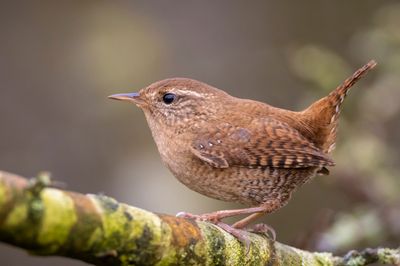


New research is revealing how different populations of wrens – some on the mainland, others across the water on islands – are evolving independently from one another. The changes are so profound that the different birds appear to be splintering off into whole new species of their own.
Led by the University of Birmingham, the study saw scientists compare how Eurasian wrens, an extremely teeny species of insect-eating bird, differ across the mainland British Isles versus those living on the rugged islands that trail off from northern Scotland.
A new species?
Those four island populations – living on Shetland, Fair Isle, the Outer Hebrides, and St Kilda – are already recognized as distinct subspecies, but the researchers suspect they are evolving into separate species of their own.
“We found that all four Scottish Wren subspecies are genetically distinct from the Wrens of mainland Britain, with the Wrens of Shetland and St Kilda being especially distinct in both appearance and song. Their genetic distinctiveness is so high that it is likely they are on their way to becoming new species,” Dr Michał Jezierski, lead author of the study from the School of Geography, Earth and Environmental Sciences at the University of Birmingham, said in a statement.
The differences are especially stark in the Shetland and St Kilda populations, which show minimal evidence of interbreeding with their mainland cousins in recent generations. Both subspecies have dramatically increased in size: a wren from England typically weighs 7 to 10 grams, while one from St Kilda can reach up to 16 grams.
Along with their chonkification, the islanders have also developed their own songs, as well as subtle differences in plumage and body proportions. The changes, the researchers explain, were vividly seen at a genetic level.
“Our genomic data indicates that Shetland and St Kilda Wrens are genetically distinct from each other, despite their similarities in physical appearance. This means that their island gigantism is a case of ‘parallel evolution’, where a similar original population (probably colonists from the British mainland) made it to each island archipelago, and then independently evolved to become island giants,” explained Dr Jezierski.
Island gigantism and island dwarfism
The Scottish island wrens are a textbook example of island gigantism, in which animals separated from the mainland grow larger over many generations.
Islands act as miniature laboratories for natural selection. Severed from the mainland, life adapts to unique local environments while remaining genetically isolated from related populations elsewhere. It’s the reason why islands are often home to weird and wonderful wildlife.
Often, the island effect will result in animals growing in size. Think: the giant wētā of New Zealand or the komodo dragon of Indonesia. Sometimes, however, they will shrink in size, a phenomenon known as island dwarfism. For instance, the recently documented Cozumel dwarf fox or the extinct “Hobbit Humans” from the Indonesian island of Flores.
Scientists still don't fully understand why these so-called "island syndromes" occur, but it goes something like this: certain animals, freed from mainland predators and with reliable food sources, benefit from growing larger. Other animals, meanwhile, tend to shrink because resources are scarce and the absence of mainland predators means they do not need to be physically intimidating.
With the help of these island-hopping wrens, the researchers hope that some clearer answers will soon come into focus.
“Our research suggests that islands with similar environments can produce similar evolutionary outcomes using different genetic pathways. The Wrens of Scotland provide us with a powerful case study to understand the mechanisms by which island biodiversity is generated worldwide,” notes Will Smith, co-author of the study from the University of Nottingham.
The new study is published in the Evolutionary Journal of the Linnean Society.