Space and Physics
 PUBLISHED
 26
26


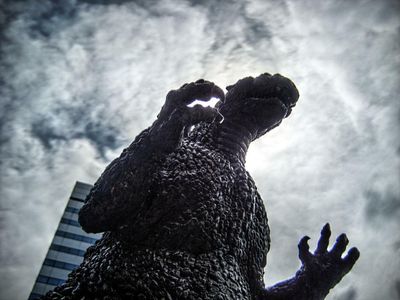


Godzilla first rampaged onto the movie screens in a fit of post-atomic anxiety in 1954, the second of two films that year to feature gigantic monsters wreaking death and destruction upon the fragile societies they encounter. It was the birth of a new genre of cinema: the kaiju movie – inspired by the legendary creatures and monsters of Japanese legend, but with a modern, nuclear-powered twist.
Even today, gigantic monsters are a staple antagonist of many good stories. From Grendel to Galactus, from Menoetius to Meg 2: The Trench, it seems humans have long been fascinated by – and afraid of – angry beings much, much bigger than they should be.
And the more worried we are, the bigger they seem to get. That first Godzilla iteration was positively puny compared to his modern incarnation in the current Legendary MonsterVerse: a 130-meter-tall (426.5 feet), 99,634-ton behemoth that equals the Great Pyramid of Giza in height and outweighs the Statue of Liberty by a factor of 3.5.
Well, we have good news for countless generations of our forebears: things are never going to get that colossal. We – and the laws of math, physics, and biology – promise.
A dimensional problem
There’s an old joke that goes like this: a farmer writes to a university, asking for help with his dairy production. A team is assembled, headed by a theoretical physicist, and weeks of investigation and calculations ensues. Shortly after, the team lead tells the farmer, “I have the solution – but it works only in the case of spherical cows in a vacuum.”
Okay, maybe it’s funnier in the physics department – but it’s also a valuable warning about the dangers of oversimplifying your assumptions for real-world problems. Go too far, and your conclusions might not hold up.
All that said, however… let’s assume Godzilla is a cube.
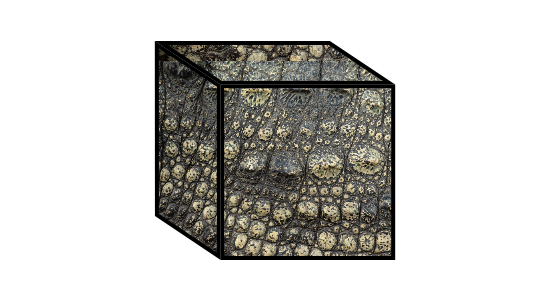
Now, math says that if we scale up the size of our hyper-low-res kaiju by, say a factor of two, the various metrics change like this: the side length doubles; the surface area quadruples; and the volume octuples – it becomes eight times what it was before.
The reason is a rule called the cube-square law, and it’s just a question of the dimensionality of your shape. But where things get a bit hairier is when you start to consider the biology of it all. See, weight increases with volume – but muscle strength increases with area, because it’s related to how thick your bones and muscles are. And if you’re hoping to grow a body to some ludicrous size, that’s going to be a problem, because the cube-square law tells us that one of those measurements increases a lot faster than the other.
To see how this works, let’s give Godzilla legs.
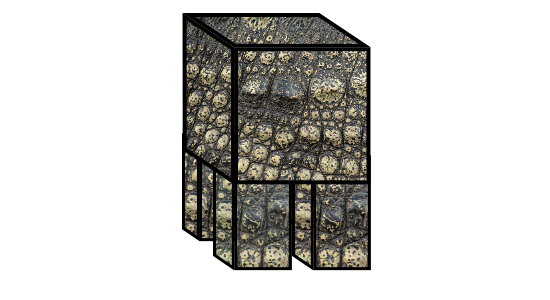
Okay, this stubby fella needs some metrics. Let’s say he’s 5 meters (16.4 feet) wide, with each leg being 10 centimeters (4 inches) wide and 20 centimeters (7.9 inches) tall, and he weighs 200 kilograms (441 pounds): that means each leg is supporting 5,000 kg/m2. That might sound like a lot, but it’s probably a chunk less than your average saltwater crocodile leg is holding up when they high walk (we chose a crocodile for comparison, since it’s one of the species Godzilla is arguably closest to).
But of course, the “real” Godzilla is not 5 meters tall. Even at its smallest, back in 1954, it was 50 meters (164 feet) tall and weighed 20,000 tonnes, and it's only grown since then. What happens if we scale our Blockzilla up to a similar size?
Well, to get from 5.2 to 50 meters tall, we need a growth factor of a little under 10 – 9.615, to be exact, which means the surface area gets a growth factor of about 92, and the volume one of 889. Now, the weight will be 177,792 kilograms (391,964 pounds) – we’re assuming Godzilla’s density hasn’t changed through his growth spurt – so each leg is supporting about 462,278 kg/m2.
That’s more than 92 times as much stress on the bones and muscles of our poor kaiju as before, and far more than any animal could realistically support. And we’re not just saying that to make life easy for ourselves – it’s legit science.
The limits of life
Is there a way around the cube-square law? Not really – the best you can do is chonk up the legs so that they can support more of the body’s weight. But doing so raises a new problem: past a certain point, explained Felisa Smith, a professor of paleoecology at the University of New Mexico, “your legs would have to be so wide to support your body that you couldn't efficiently walk.”
It’s for this reason that the biggest land animals ever known top out at around 90 tonnes – close to the theoretical maximum of around 110 tonnes, Smith told Live Science back in 2023. That’s notably less than our 50-foot crocodilian cube, and many orders of magnitude less than the 20,000 tonnes Godzilla supposedly weighed back in his youth.
And physics isn’t the only limit on how big things can get. Godzilla has an advantage over, say, King Kong, because his reptilian metabolism likely runs slower than a mammalian one – that’s why it’s “not surpris[ing]” that “the largest dinosaurs in terrestrial areas were about 10x bigger than the largest mammals,” Smith told Live Science.
But again, metabolic rate scales with body mass, so the 1,000 kcal per day average required by a regular croc becomes 889,000 kcal for Godzilla. That’s the equivalent of eating, like, 1,700 Big Macs every day – more than one a minute. Evidently, blue whales are onto something with their 40-million-krill-per-day diet – but short of a land-based equivalent, Godzilla is going hungry.
And sure, you might say, that’s fine, actually – famously, Godzilla “eats” nuclear radiation. But consider this: it also expels it by the kiloton every time it releases its atomic breath. And that’s not the only thing increasing its metabolic rate: it also moves at incredible speeds for its size, and has, we assume, a functioning circulatory and nervous system. Both of these are “dealbreaker[s]”, The Science Of’s Matt Brady points out: “Physically, a larger animal has less muscular force per mass than a smaller animal does,” he writes, while blood vessels “have limits on their lengths – too long, and the oxygen can’t reach the parts of the cell efficiently.”
Overall, then, a beast of Godzilla’s size would move slowly and clumsily; it would react slowly – reminder that it can take more than six seconds for a blue whale to realize you kicked it in the tail; it would barely ever eat – but when it did, it would be a meal with the caloric equivalent of an early atomic bomb; it would likely massively overheat constantly; it would, Brady writes, “have […] epic poops.”
And even if all of those problems were overcome, the cube-square law would still scupper it in the end. Either too large to exist, or too thicc to move; either way, Godzilla is grounded – which is no doubt a relief to the much-embattled residents of Tokyo through the decades.
All “explainer” articles are confirmed by fact checkers to be correct at time of publishing. Text, images, and links may be edited, removed, or added to at a later date to keep information current.