


 Nature
 PUBLISHED


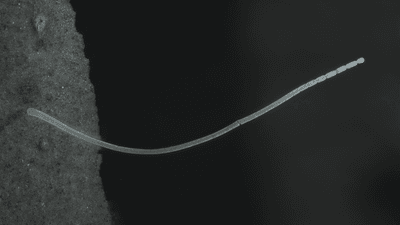


While sampling a swamp in Guadeloupe back in 2009, scientists discovered something unusual. About a centimeter long and looking like a pale eyelash, they’d found a bacterium they couldn’t identify. Weirdest of all, it was far bigger than any bacteria ever found before. Far bigger, even, than we thought possible.
“When I saw them, I thought, ‘strange,’” said Olivier Gros who made the discovery as a marine biology professor at the Université des Antilles in Guadeloupe, in a statement. “In the beginning I thought it was just something curious, some white filaments that needed to be attached to something in the sediment like a leaf.”
At first it was assumed they were eukaryotes because they were too big with too many filaments to be bacteria. A closer look revealed that the identified noodles were some kind of single-celled organism, raising the question as to whether they had found a macro microbe.
Realizing they had something big on their hands – both literally and academically – they began a series of investigations that would support a huge announcement that wouldn’t arrive until 2022: they had found the world’s largest bacteria.
So big are they, in fact, that they're visible to the naked eye. Typically you’d need a microscope to be able to visualize a microbe – the clue is really in the name – but not Thiomargarita magnifica.
“It’s 5,000 times bigger than most bacteria,” said study author Jean-Marie Volland. “To put it into context, it would be like a human encountering another human as tall as Mount Everest.”
Most bacterial cells are microscopic, typically around two micrometers in length. Some "giant bacteria" can be a few hundred micrometers, a size that scientists have previously believed to be the theoretical maximum for the size of a bacterium, but T. magnifica shattered that.
It’s a slightly alarming prospect given humans are covered (inside and out) with microbes. However, it’s not thought to be a pathogen for humans and therefore isn’t going to cause you any problems should you find yourself in a swamp in Guadeloupe.
It forms part of a very interesting habitat, however, as mangroves (along with other kinds of swamps) are celebrated for their impressive carbon sequestration. They contribute to around 10-15 percent of the carbon stored in coastal sediments despite representing less than 1 percent of the coastal area worldwide. Therefore, figuring out what role a giant sulfur-oxidizing, carbon-fixing megabacterium is doing there could have many potential applications.
And if seeing a massive bacterium doesn’t already have you feeling confused, why not listen to the “beautiful and interesting” rumble of one of the world’s largest living organisms?

 1
1