Humans
 PUBLISHED

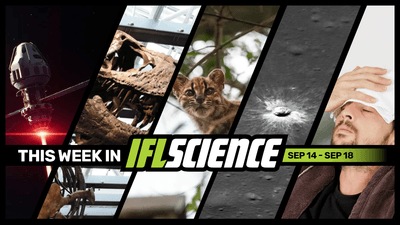


This week, the long-standing debate around whether T. rex was cold- or warm-blooded may have finally been answered, this adorable tiny tiger from Bolivia is the first new cat species to be discovered in over 100 years, and the Moon’s new 200-meter-wide crater is the largest fresh impact ever found. Finally, as fear around “ultra-processed foods” grows, we ask what defines a UPF, and if it’s really the question we need to be asking.
Create an IFLScience account to get all the biggest science news delivered straight to your inbox every Wednesday and Saturday.
The US Has Admitted For The First Time That It Placed Weapons In Space – What Does This Mean?
Speaking at the Air, Space, and Cyber Conference on September 14, US Secretary of the Air Force Dr Troy Meink confirmed that the United States had deployed a space weapon in Earth’s orbit. The admission is a game changer when it comes to the militarization of outer space, so we spoke to experts in space law to understand the consequences. Read the full story here
T. Rex Teeth Reveal It Was A Hot-Blooded Beast Capable Of Living In The Deep Cold
The long-standing debate as to whether dinosaurs were warm- or cold-blooded may finally have been settled for the most famous member of that giant clade. Teeth from a T. rex named Thomas grew at temperatures very similar to those inside a human body, and it almost certainly wasn’t because the air temperatures in which Thomas lived were that hot. Read the full story here
First New Cat Species In Over 100 Years Is A Totally Charming Tiny Tiger From Bolivia
The tiger cats are one of the shyest, most cryptic groups of animals. They're all smaller than domestic house cats and live secret lives within the jungles and grasslands of South America. Now a new species has joined the party, based largely on a single animal that lives in a sanctuary in Bolivia named Tilcayo. Read the full story here
The Moon Has A Massive New Crater Over 200 Meters Wide – That’s Larger Than The Colosseum
NASA’s Lunar Reconnaissance Orbiter (LRO) has orbited the Moon for 17 years, mapping its surface with unprecedented precision. The Moon has no winds or flowing water, but it does change under the effects of cosmic events. Impacts from other space objects are among them, and now LRO has caught the biggest of its career: the largest fresh impact crater on the Moon ever found. Read the full story here
Why Do Some People Get Vaccine Side Effects And Others Don’t? Scientists Find New Clues In The Ways Our Immune Systems Respond
Here’s a little experiment for you: ask a few friends and family members about their experience of getting their last flu shot or COVID booster. Chances are you’ll get a rough split between the “I had a headache and couldn’t lift my arm for days” people and the “didn’t feel a thing and ran a half-marathon the next day” people. Why is that? Read the full story here
TWIS is published weekly on our Linkedin page, join us there for even more content.
Feature of the week:
What Counts As An Ultra-Processed Food? It's A Surprisingly Tricky Question – And It May Not Even Be The Right One To Ask
Something is poisoning the American people. At least, according to Robert F. Kennedy, Jr: “chemically processed foods […] are truly making us sick,” he argued. “They are not only contributing to chronic disease, but mortality from infectious disease.” Eating these so-called “ultra-processed foods” might give you cancer, we’re warned; they could be messing up your heart health; in fact, they’ve been linked to damage in every major organ in the human body. They may make you age faster; they can even make you depressed. It is, it seems, a pretty bleak picture. Except – well, what if it’s not? Read the full story here
More content:
Have you seen our e-magazine, CURIOUS? Issue 50, September 2026, is available now. This month, we asked, “Why Is It So Funny Watching People Fall Over?” – check it out for exclusive interviews, book excerpts, long reads, and more.
PLUS, the We Have Questions podcast – an audio version of our coveted CURIOUS e-magazine column – continues. In episode 24, we ask, “Could You Turn A Flamingo Blue?”
The Big Questions podcast continues as we ask, “What's The Next Frontier In Dementia Research?” Host Laura Simmons speaks to three scientists looking at dementia from three quite different perspectives. Together, these conversations take us on a journey through some emerging and innovative aspects of dementia research, and give us a glimpse at what the future may hold.


 1
1