


 Humans
 PUBLISHED


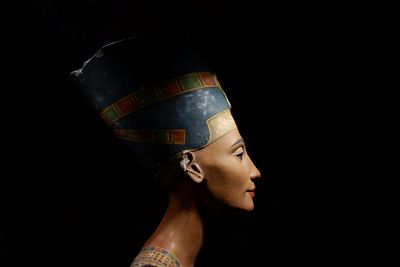


The tomb in which Tutankhamun’s mummy was discovered in 1922 may originally have been built for a different ruler, before being adapted to house the remains of the Boy King following his untimely death. According to a team of researchers, these modifications included the construction of a series of false walls, beyond which may lie the burial chamber of the tomb’s original owner, Queen Nefertiti.
Ruling Egypt immediately before Tutankhamun, Nefertiti was a key figure within the Amarna royal family, and may even have been granted full Pharaoh status under the name of Smenkhkare.
Her body has never been found, although in 2015 British Egyptologist Nicholas Reeves proposed that she may be lurking in a concealed room beyond the walls of Tut’s tomb, which is referred to by archaeologists as KV 62.
Previously, a number of experts – including Howard Carter, who first uncovered KV 62 – had noted that it seems rather small for a royal burial chamber. Reeves then pointed out that the structure is a “left-turning monument”, and therefore conforms to the architectural norms of a queenly burial chamber from the Eighteenth Dynasty.
He therefore suggested that the tomb was originally built for a female ruler who immediately preceded Tutankhamun, making Nefertiti the only logical candidate. According to Reeves, the front part of KV 62 was then repurposed to accommodate Tutankhamun after his unexpected death, at which point Smenkhkare’s burial chamber became concealed behind the newly constructed partitions.
In a new study, archaeologists including Reeves review the findings of seven major field campaigns conducted since he proposed his theory in 2015.
Using a range of techniques, including ground penetrating radar, thermal imaging, electrical resistivity tomography, microgravimetry, and geological mapping, these investigations sought to reveal hidden chambers lying beyond the walls of Tutankhamun’s burial chamber.
According to the authors, these studies have “identified with high probability the presence of a funerary complex of generally recognisable type extending some 25-30 meters [82-98 feet] to the north of KV 62.”
“Five or six chambers are likely to exist in this space, and there is a clear expectation that the voids detected connect to themselves and to KV 62 by passageways deliberately filled with rubble in antiquity,” continue the researchers.
To confirm the existence of these spaces – and to determine who, if anyone, lies within them – archaeologists will need to physically open up the walls of KV 62 and peer inside using a small camera. Authorization for such an invasive investigation is yet to be granted, although the study authors have applied for permission and hope to finally take a look beyond the walls of Tutankhamun’s tomb later this year.
“Should such an extension eventually be confirmed, it would represent not merely the most important discovery in the Valley of the Kings since the uncovering of Tutankhamun’s tomb in 1922,” they write.
“It could potentially rank among the most transformative archaeological discoveries of the modern era, fundamentally reshaping our understanding of the political, religious, and dynastic history of the Amarna Period itself.”
The study is published as part of the Amarna Royal Tombs Project.

 1
1