Humans
 PUBLISHED



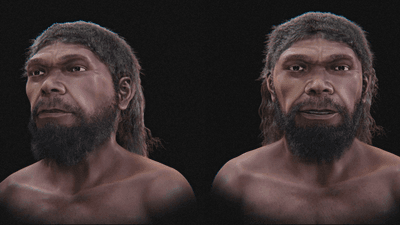


As far as we know, Homo sapiens first appeared in North Africa a little over 300,000 years ago before spreading across the globe. However, these original members of our species possessed some cranial features that weren’t quite like ours, and a new facial approximation gives us our best guess yet of what they actually looked like.
Discovered in 1961 by miners at Jebel Irhoud in Morocco, a fossil skull known as Irhoud 1 was initially categorized as an African Neanderthal with an age of about 40,000 years. Yet as more remains and stone tools were recovered from Jebel Irhoud over the following decades, it became increasingly clear that this interpretation was incorrect.
In 2017, a major new analysis revealed that the Jebel Irhoud hominins were in fact Homo sapiens that lived approximately 315,000 years ago, making them the oldest known modern humans. Yet while their general facial structure and dentition appear to match ours, these ancient humans also possessed braincases that resemble those of older hominins.
In addition to providing new clues as to where and when our species first appeared, these findings also revealed that our brains evolved more slowly than our faces and continued to undergo modifications after our basic appearance had been forged.
To determine what these early Homo sapiens might have looked like, the authors of a new study created a digital model of a composite 3D skull made up of multiple Moroccan specimens. The majority of the face and cranial vault came from Irhoud 1, while the jawbone was supplied by another individual labeled Irhoud 11, and some of the teeth belonged to Irhoud 10, 21, and 22.
Like a kind of prehistoric Frankenstein's Monster, these various disembodied components were pieced together to produce a complete human skull. The resulting composite has a brain volume of 1230 cubic centimeters, roughly matching that of the average modern adult male.
The researchers then virtually meshed this model with that of a real modern human face, which was distorted to match the proportions of the Jebel Irhoud skull. This enabled the study authors to map the distribution of soft tissues across the cranium, essentially giving the fossil a face.
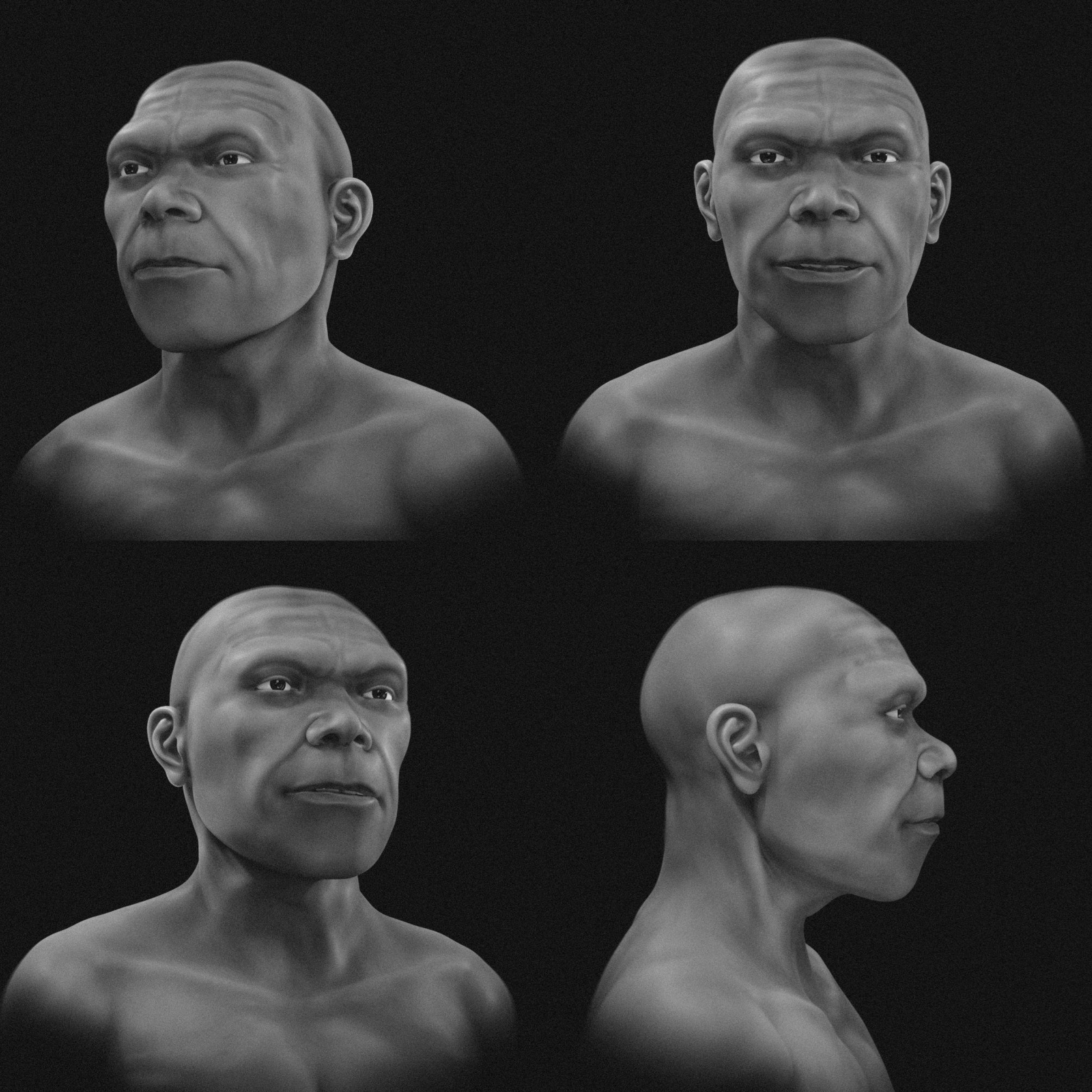
Two versions of this reconstructed face were then produced, the first of which is presented below in grayscale with no facial hair, in order to give an objective approximation of what the Jebel Irhoud hominins might have looked like.
Permitting themselves the use of artistic license, the researchers then created a colored version of the image, bringing the face to life by adding in hypothetical details such as skin pigmentation and facial hair.
According to the study authors, these representations provide a decent snapshot of some of the earliest Homo sapiens to walk Earth, although they caution that it is impossible to know for sure what these people truly looked like.
Acknowledging the weaknesses in their approach, they point out that the recreated face comes from a skull built from multiple specimens and therefore doesn’t correspond to any actual individual. They also note that all soft tissue thickness markers are derived from modern Homo sapiens and might therefore differ from the actual values exhibited by the Jebel Irhoud humans.
“Because no direct soft-tissue data exist for Middle Pleistocene hominins, the use of reference datasets derived from modern human populations represents a necessary methodological proxy rather than an assumption of biological equivalence,” write the researchers.
Unless we stumble on some truly exceptional fossils with preserved facial soft tissue, these images are probably the closest we’ll ever get to seeing the faces of our earliest ancestors.
The study has been published in the journal Heritage.