Humans
 PUBLISHED



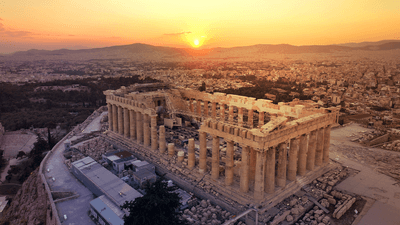


A mathematician in the UK has examined and challenged "one of the oldest and most enduring myths in human history", as the researcher debunks the architectural myths about how the Parthenon was built.
Built between 447 and 432 BCE, the Parthenon remains one of the most impressive structures of the ancient world. Overlooking Athens, it was originally built as a temple dedicated to the city's goddess Athena Parthenos.
Over its time, however, the Parthenon has been used for a variety of functions, including a mosque, a church, a treasury, and a gunpowder store. An unfortunate decision that resulted in a lot of damage when Venetian forces attacked in September 1687 and blew the store up.
Despite all this, the Parthenon still stands tall above the city thousands of years later.
Like with the pyramids of the Ancient Egyptians, it is perhaps unsurprising then that rumors and myths have been built around it.
In the case of the Parthenon we don't have many decent alien conspiracies to talk of, but there are several myths that claim the architects behind the Parthenon were especially clever with their design.
Now, mathematician Alain Goriely has debunked these 2,000-year-old myths in a new study.
Myths as old as time (or, the Romans)
There are various architectural myths surrounding the building that state it was built as something of an optical illusion. So repeated are these ideas that over the centuries they have become accepted truths, with no one really figuring out if they're actually correct.
That was until Goriely came along. He has delved not only into the veracity of these myths, but went all the way back to their surprisingly ancient source.
Goriely found that the ideas about the Parthenon's optical illusions actually date back almost as long as the building itself, give or take four centuries. It turns out that they all come down to the Roman Vitruvius, who first wrote about them in the first century CE.
But Vitruvius was "notorious for having misunderstood many aspects of Greek architecture," writes Goriely.
"In De architectura (first century BCE), the only surviving complete architectural treatise from antiquity, he states that certain refinements, such as the slight curvatures in stylobates (myth 1), column entasis (myth 2), larger corner columns (myth 3) and scale corrections (myth 4), were made to counteract visual illusions, specifically the appearance of sagging, concavity in long horizontal lines, or changes in size."
Vitruvius's writings were rediscovered and largely passed on as truths. Even almost 2,000 years later, these "facts" about the Parthenon appear in everything from books about the building's history, to the current generation of AI chatbots.
But we don't actually have much in the way of evidence that this version of events is correct.
Bendy stylobates and bulging columns
According to the myths, the Parthenon's architects Ictinus and Callicrates made use of a number of optical illusions in order to pretty up the place.
These included using curved elements so that, when viewed from the right angle, it made the straight line of the building appear not to sag in the middle. Meanwhile, corner columns were said to be thicker, supposedly offsetting an illusion of the light which would make them appear thinner than all the others.
Another rumor relates to the iconic columns that surround the structure.
"The columns themselves are not straight along their vertical axes, but swell in their middles," tourism site Greece Is says about the columns.
"This phenomenon, called 'entasis,' intended to counteract another optical effect in which columns with straight sides appear to the eye to be slenderer in their middles and to have a waist."
Debunking the Parthenon myths
Looking into all these potential illusions, Goriely found little evidence of their existence. For example, the columns only bulge by around 18mm in the middle, a difference that would be too small for viewers to detect at most distances.
"Moreover, when perceived, it registers to the eye as a bulge rather than as a correction," Goriely adds.
"A simpler alternative explanation is that builders used curved columns because they believed them to be more pleasing than straight ones."
In short, none of the illusions supposedly placed into the Parthenon to counteract other optical illusions appear to actually work or be perceptible to anyone viewing it.
Goriely suggests that the myths endured for so long due to a number of factors, including the romanticization of Ancient Greeks as a pinnacle of knowledge, and the subjective nature of optical illusions. Fortunately, the solution to such myths, even when held for this long, is that they can be tested.
"Despite wide individual variations, illusions can be measured carefully in laboratories, or in situ and estimated theoretically," Goriely writes.
"The proponents of a theory of optical corrections should not turn to the prose of Vitruvius but to experimental psychologists. If they believe an effect exists, then it needs to be properly documented and reproduced. The Parthenon replica in Nashville, Tennessee, would be a good place to carry out these experiments."
The study is published in Royal Society Open Science.