Nature
 PUBLISHED


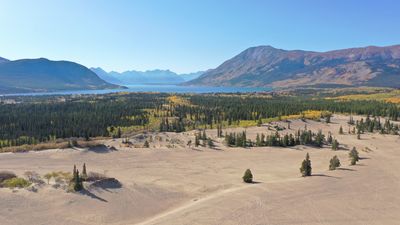


The world’s deserts are often big, always striking, and occasionally covered in snow. But there’s one out there that claims a more modest title: Carcross Desert, the smallest desert in the world.
Spanning just 2.6 square kilometers, or one square mile, it’s only about three-quarters the size of Central Park – unlike the deadly dunes of, say, the Sahara, this desert takes a hefty 10 minutes or so to cross entirely. But the strangest thing about Carcross Desert isn’t really its size at all. It’s…
Well, it’s kind of everything else.
What the Carcross Desert is (and is not)
In the middle of Canada, surrounded by vast lakes and often covered in snow, is probably not where you’d expect to find a sand desert. And, to be fair, you’d be correct in that expectation – because the first thing you have to know about Carcross Desert is that it’s not, technically, a desert at all.
“There are almost as many definitions of deserts and classification systems as there are deserts in the world,” acknowledges the United States Geological Survey (USGS) – but the most widely accepted system depends on precipitation.
“Extremely arid lands have at least 12 consecutive months without rainfall, arid lands have less than 250 millimeters of annual rainfall, and semiarid lands have a mean annual precipitation of between 250 and 500 millimeters,” the USGS explains. “Arid and extremely arid land are deserts, and semiarid grasslands generally are referred to as steppes.”
To be a true desert, then, Carcross would need a maximum of 25 centimeters (9.8 inches) of precipitation per year. But the closest monitoring station, in nearby Whitehorse, reports a whopping… 27 centimeters (10.6 inches). Oof.
That the area stays so dry is due to simple geography. “The Carcross Desert sits in a ‘rain shadow’,” explained weather.com senior meteorologist Jonathan Erdman. “Moist winds from the northeast Pacific are intercepted by the mountains to its west and south, robbing most of the rain and snow of those moisture-laden storms.”
“Second, the moistest time of year along the Gulf of Alaska coast is also the time when bitterly cold, dry Arctic air masses build into the Yukon Territory from Siberia and Alaska,” he pointed out, “further depriving the area of potential for precipitation.”
Still, the area is more properly called a dune field than a desert – though “you can certainly call it a wet desert,” agreed Panya Lipovsky, a surficial geologist from the Yukon Geological Survey, speaking to BBC Travel in 2018. After all, it’s certainly not grassland: “[W]ith so much sand and sediment blown in, there’s no chance for the vegetation to regenerate,” Lipovsky added. “It’s a truly dynamic system.”
The origin of Carcross
The story of Carcross’s unique geography starts more than 10,000 years ago. Back then, North America was covered in ice as far south as modern-day Indianapolis – oddly, Alaska of all places was ice-free, but that’s by-the-by – and Carcross itself “would have had 1km of ice sitting on top of it,” Lipovsky explained. “You just can’t picture it.”
But as the ice retreated, the glacial lakes that had existed in the south Yukon shrank. In their place was sand and silt; stranded little beach islands tucked in between smaller lakes and valleys.
That was the foundation for Carcross – but what sealed its destiny as the “desert” it is now was the newly exposed mountains and valleys in the area. Winds, made stronger and more erratic as they blew through the valleys, hoovered up sand from the south-east and brought it up to the Yukon, resulting in the sandy scenes so famous today.
“There’s a misconception it’s the result of a dried-up lake, but that’s not the case,” Lipovsky told the BBC. “Strong prevailing winds continue to whip along Bennett Lake today, blowing exposed fine-grain sands into the dunes. So the combination of the wind, the water and the Ice Age created a distinctive set of circumstances.”
Life in Carcross
Yukon is an almost-entirely landlocked province with a uniformly subarctic climate. It’s no surprise, therefore, that a little pocket of sandy “desert” would be popular among the locals – be they human or otherwise.
In fact, that’s how the place got its name. “Massive herds of woodland caribou would cross here,” Keith Wolfe Smarch, a member of the Tlingit First Nation who lives in the nearby community of Carcross, told the BBC. “As nomadic people, both the Tlingit and Tagish tribes camped beside the nearby Natasaheen River to hunt – so the town’s name comes from a portmanteau of caribou and crossing.”
Before Carcross, the area was Naataase Heen – “water running through the narrows” in the local Tagish language. And indeed, the two First Nations who still live there today have a long, long claim to the area. They and their ancestors have populated Carcross for thousands of years, relying on the plentiful caribou, rich mineral deposits, and surprisingly lush flora for their livelihoods.
“The desert has long been an enigma to us locals,” Wolfe Smarch said. “There’s plenty of rare vegetation that lives down by the beach on the Carcross River and one day the desert will swallow it up. It shapes our town.”
Today, however, the Tlingit and Tagish aren’t the only people who come to Carcross. The area is a popular hiking spot – you need only look at photos of the desert and surrounding lakes to see why – and the desert itself is a haven for adventure sports enthusiasts. In summer, the dunes are used by quad bikers and sand-boarders; in winter, the skiers and snowboarders descend. So popular are these activities that they actually scuppered an initiative to officially protect the desert back in 1992 – the locals’ desire for sandy, hilly fun was just too strong.
But if you’re rolling your eyes right now at the perverse priorities of humans, fear not: to a certain extent, human interference is actually good for Carcross Desert.
The future of Carcross
Carcross Desert is not technically a desert – but, we’re sad to say, neither is it really the “one square mile” it’s reputed to be. A more accurate way to characterize this little niche of Yukon is this: it’s the last piece of a 2.5 kilometer-long dune field that has not yet succumbed to the forest.
“People, you know, talk about protecting the boreal forest, but in Yukon, the boreal forest is a bit of a slow moving invader,” Bruce Bennett, a conservation data centrer coordinator for the Yukon government, told UpHere Magazine in 2021. “And so, left unchecked, it slowly smothers some of our truly rare habitats.”
Without disruptive activity, the larger Carcross dune field would disappear altogether, he explained – swallowed like so many other rare areas by the Yukon boreal forests. But it’s a delicate balancing act, and the center of the field – the “desert” proper – is an example of what happens when things swing too far in the other direction.
“All the plants that used to be there and all the insect communities and all those sort of things, [now] you have got nothing but sand because it’s too active,” Bennett explained. “There are too many vehicles, too much stomping.”
The Carcross Desert, he said, has been “loved to death” at this point. “It’s really good to wander around […] but too much wandering can also create problems.”