Nature
 PUBLISHED


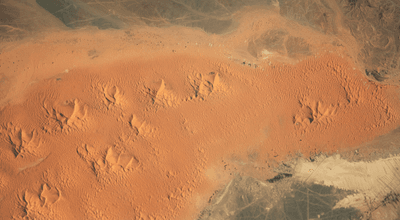


Viewed from space, the western edge of the Sahara Desert looks like another world. Its abundance of red-tinged sand turns into a sea of dunes that ebb and flow with the wind, unabated by foliage and other earthly obstacles.
An astronaut aboard the International Space Station recently took this photograph while orbiting over southeastern Morocco, not far from the border with Algeria.
The beautiful image, recently shared by NASA Earth Observatory, captures an area called Erg Chebbi, a sand sea that covers an area of 18 by 9 kilometers (11.2 by 5.6 miles) in North Africa.
The stretching sand sheet contains numerous features including star dunes, also known as pyramid dunes. These mounds are formed by wind blowing masses of sand from multiple directions, creating a dune with a central peak and several "ridges" that radiate outward, like a star shape or pyramid.

Although commonly associated with the Sahara, star dunes can also be found in the Arabian Peninsula, China, and North America, as well as elsewhere in the Solar System, such as Mars and Saturn’s moon Titan.
This type of dune can form some of the tallest on Earth, reaching up to 300 meters (984 feet) high in other parts of the world like the Badain Jaran Desert in China.
“Despite their large size and prominence within sand seas, or possibly because of their large size, star dunes are the least studied dune type,” comments a 2024 paper in the journal Nature.
Erg Chebbi may seem like an inhospitable landscape, but as ever, life finds a way. Towards the bottom of the dune complex, there’s a large aquifer that supports palm groves and the town of Marzouga.
At the top of the dunes, it’s possible to just see a small cluster of camps. Traditionally, these types of camps would have belonged to the Indigenous Amazigh (Berber) peoples, who lived nomadically in North Africa for millennia. Today, however, they are mainly frequented by tourists who are keen to experience the Sahara Desert with their own eyes.