Nature




China is a big place – and the farther west you go, the bigger it gets. By the time you get to Xinjiang, the country’s westernmost province, on the borders of Tajikistan, Kyrgyzstan, Afghanistan, and five other central Asian countries to boot, you could be forgiven for thinking you’re not in China at all: the cities are dotted with mosques and Arabic script alongside the pagodas and Hanzi; the people speak Uyghur, a tongue more closely related to Kazakh or Turkish than the official state language of Mandarin.
It’s a region bigger than France, Germany, and Spain combined. More than one-fifth of it is the Taklamakan: the biggest desert in China, which looks like the Sahara, feels like the Arctic, and has a name that reputedly translates to “the place of abandonment” or “place of ruins”.
And, throughout this vast and unique land, the White and Black Jade Rivers flow, meeting and combining as the Hotan River some 140-ish kilometers (87 miles) north of the eponymous oasis town. If you’re wondering how they got their names… well, it’s not that complicated.
Why is Hotan River special?
Language can tell you a lot about what a culture considers important. For example, in English, if somebody is born into wealth and generational power, you might say they were born with a silver spoon in their mouth. If you have a particularly great idea – a real gem, you could say – you’ve struck gold. A favored son or daughter might be called the golden child of the family; a particularly honorable person – even one who might lack refinement at the moment – could be a diamond, albeit in the rough.
What do all of these idioms have in common? In Chinese, they all involve jade.
“Jade is [extremely] highly valued in Chinese culture”, wrote Juliette Hibou, an Assistant Gemmology Tutor at the Gemmological Association of Great Britain, back in 2019. “It is believed to possess the power to avert evil and bad luck while fostering health and good fortune.”
Indeed, this reverence for jade can be traced back thousands of years – far earlier than even Chinese written records began, with artefacts such as jewelry and vessels found dating back to the third millennium BCE. It gained a reputation in Imperial times as the gem of royalty; today, the country’s nephrite market alone is estimated to be worth some $30 billion USD.
“Confucius reportedly expressed this fascination by making jade a metaphor for virtue, kindness, wisdom, justice, civility, music, sincerity, truth, Heaven and Earth,” explained Hibou. “A Chinese saying states that ‘you can put a price on gold, but jade is priceless’.”
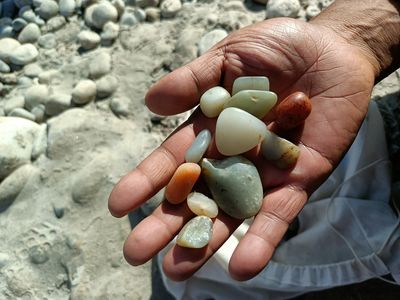
Why is all this important, you might ask. Well, there’s something special about the Hotan River, as well as the Black and White Jade Rivers that combine to form it: their waters are filled with hunks of jade.
“Sometimes we find no jade, but usually we can find around ten pieces a day,” Mehmet Misrah, a jade prospector in Hotan, told The Telegraph back in 2008. “The very best stones go for up to a million yuan [about $212,765 USD, accounting for inflation]. The people who find those pieces stop working and do the Hajj to Mecca.”
The jade lifeblood of Hotan
With such a huge cultural crush on jade, you’d expect that a river full of the stuff would be popular. It might come as a surprise, therefore, to learn that until 1990 or so, the Hotan River was something of a secret, even within China.
Why? Well, it’s kind of ironic that such a horde of this precious mineral should be found in Xinjiang – because, as Muslims, removed from the dominant Han culture of China, the local Uyghurs traditionally aren’t all that interested in jade.
Indeed: “Jade has no meaning for our culture,” Yacen Ahmat, a jade seller in the Hotan bazaar, told the New York Times back in 2010, “but we are thankful to Allah that the Chinese go crazy for it.”
Forty years ago, the jade that sparkled in the waters around Hotan was treated just like any other river rock – but once people back East got wind of its presence, it triggered the jade equivalent of a gold rush. Prices shot up to 10 times what they had been a decade earlier; gram-for-gram, the stones had become more valuable than gold.
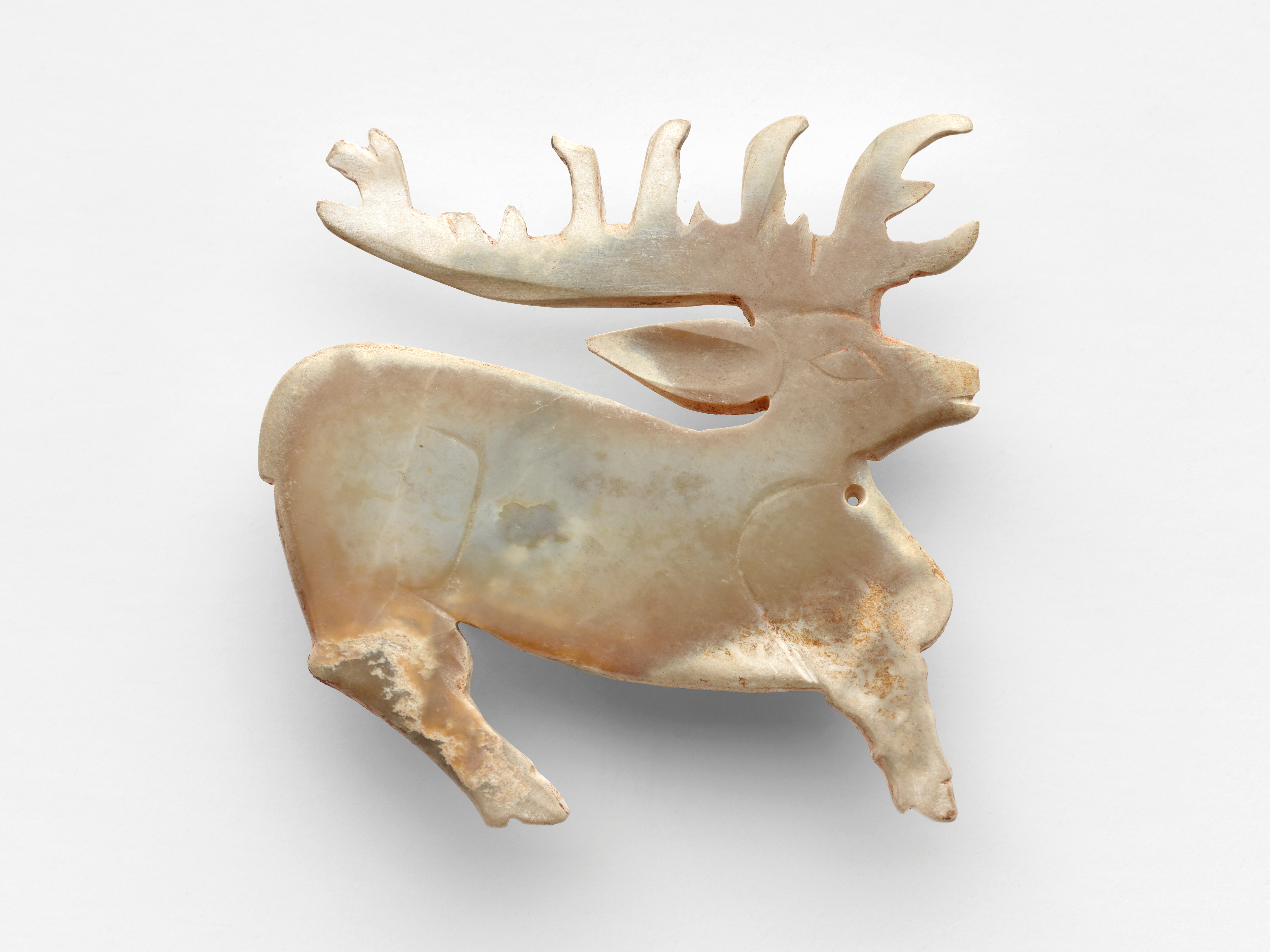
But as much as the allure of Hotan River jade is a modern phenomenon, it’s also very, very old. Not for nothing is Hotan known as an “oasis town”. Sitting within the “biological void” of the Taklamakan, it ought to be inhospitable to basically everything – and yet, thanks to an extremely lucky set of geographical circumstances, it’s been a hotspot of trade and culture for nearly 1,000 years. It has water; jewel-filled mountains to shade it from the elements; it’s mid-way between Shanghai and Baghdad, placing it perfectly along the Silk Road that connected Western Europe to Eastern Asia all those centuries ago.
The question is this: can it last forever?
Protecting the jade
To understand the jade of the Hotan River, there’s something you have to know: jade… isn’t a thing.
At least, it isn’t one thing. When somebody talks about “jade”, they could be referring to one of two different types of rocks: jadeite or nephrite. These look superficially similar, but that’s about it: “they constitute completely different minerals,” explains the International Gem Society (IGS), “with different properties and natural formation processes.”
To make matters worse, both of these minerals come in countless varieties, with tiny differences in the constituent molecules producing a wide range of colors and patterns. While the name “jade” is basically synonymous with shades of green, it’s totally possible to get blue or purple jadeite, red or black nephrite, and white or yellow varieties of either.
So, which type of jade is found in the Hotan River? That would be nephrite: the very dense, fibrous version of jade which is surprisingly closely related to asbestos – though “[w]earing nephrite jewelry and handling rough or finished pieces pose no known health risks,” IGS assures. This is, in a way, the “original” jade: “Chinese artisans crafted extraordinary jewelry and artistic works from a stone called yu for thousands of years,” explains the IGS, with jadeite jade being introduced to the country from Myanmar in the mid-18th century.
The nephrite jade, then, has been in the Hotan River and nearby Kunlun Mountains for… well, forever, really. But when interest in Hotan jade exploded, the more obvious deposits quickly dried up: the larger pieces became scarcer; then the smaller pieces; eventually, even extensive digging operations, with heavy equipment to tear up the landscape, were going home empty-handed.
It was enough to prompt some soul-searching from the Xinjiang authorities. In 2007, they revoked all mining licenses and banned commercial excavation of jade along the Hotan River – once the environment had a chance to heal, district officials said, extraction could restart in a more “legal and orderly” fashion.
After all: if jade doesn’t deserve respect, then what on Earth could?
“Hotan jade isn’t like coal or oil – it’s a very special resource that’s been with us for thousands of years,” warned Wang Shiqi, a geology professor and jade specialist at Beijing University, in an interview with the Seattle Times back in 2006. “If we continue unlimited exploitation, we’re in danger of irreparably damaging Chinese culture.”