Nature
 PUBLISHED
 15
15



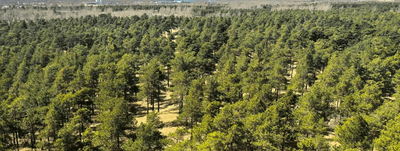


China has a new Great Wall, but this one isn't built of stone and mortar to repel marauding invaders from the north. Instead, the “Great Green Wall” is a vast belt of trees and shrubs lining the bottom of its northern deserts, designed to halt the steady creep of desertification. New research suggests this massive megaproject is already functioning as a vital carbon sink, helping to stabilize the local environment.
Located in northwest China’s Xinjiang Uyghur Autonomous Region, the Taklamakan Desert is one of the driest places on Earth and the largest desert in the country. It’s sometimes called the “Sea of Death” and “The Place of No Return” because of its desolate landscape, defined by towering dunes and a scarcity of wildlife.
Since 1978, China has spearheaded an unprecedented afforestation campaign along its northern edge, planting greenery to prevent the desert from swallowing up surrounding farmland. It would also double up as a natural barrier against sandstorms, some of which are so gusty they reach Beijing. It's one part of China's Three-North Shelterbelt Forest Program, a massive initiative to hold back the expansion of the Gobi Desert and other arid areas through afforestation.
In 2024, the government announced the completion of a 3,046-kilometre (1,892-mile) green belt around the desert through the planting of billions of trees and shrubs. While some critics questioned whether the Taklamakan Afforestation Project would deliver meaningful environmental benefits, new research led by scientists at the University of California, Riverside, suggests it is already making a measurable impact on both the local ecosystem and the global carbon cycle.
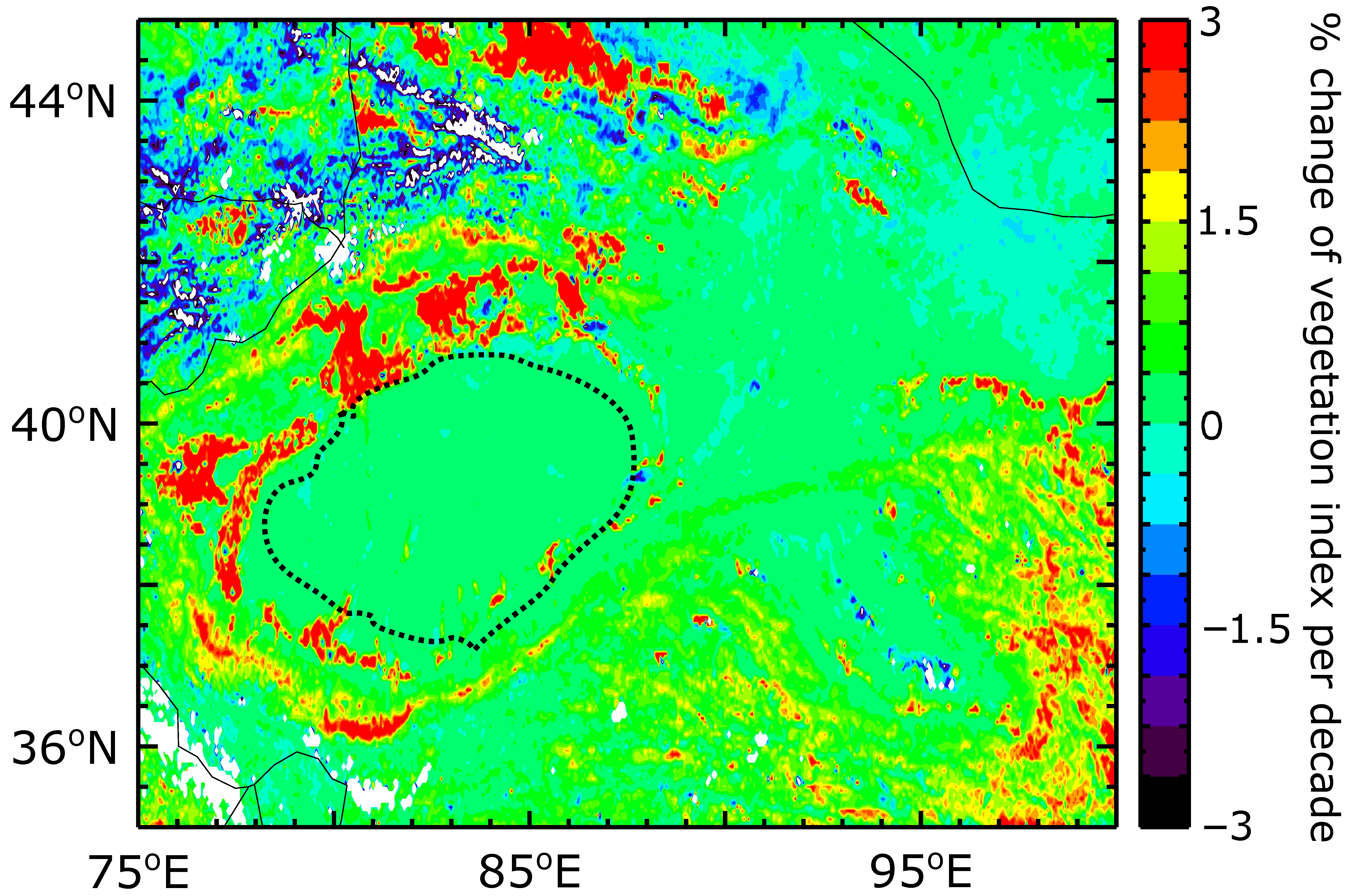
In the study, researchers analyzed satellite data of the Taklamakan Desert to track atmospheric carbon dioxide levels and solar-induced fluorescence, a reliable indicator of photosynthesis and plant growth.
This showed that the increased photosynthetic activity has effectively turned the desert into a carbon sink. Between 2004 and 2017, the Taklamakan Desert absorbed about 8.3 million tons of CO2 per year while only releasing about 6.7 million tons, “sucking up” huge amounts of greenhouse gas from the atmosphere.
“This is not a rainforest. It’s a shrubland like Southern California’s chaparral. But the fact that it’s drawing down CO2 at all, and doing it consistently, is something positive we can measure and verify from space,” King-Fai Li, study co-author and atmospheric physicist at the University of California, Riverside, said in a statement.
It isn’t just plants that are absorbing carbon from the atmosphere, either. Recent research has suggested that desert sand can physically trap smaller but significant amounts of CO2 through expansion and contraction cycles caused by temperature swings throughout the day.
The researchers say their work provides “direct evidence” that human-led intervention can effectively enhance carbon sequestration, even in one of the world’s most extreme arid landscapes. However, they warn that climate change won’t be kept at bay through afforestation projects alone. To fend off the deepening climate crisis, the world will need a multi-pronged approach, centred around the phasing out of fossil fuels.
“We’re not going to solve the climate crisis by planting trees in deserts alone. But understanding where and how much CO2 can be drawn down, and under what conditions, is essential,” Li explained. “This is one piece of the puzzle.”
The new study is published in the journal Proceedings of the National Academy of Sciences.