


 Nature
 PUBLISHED




What you'll discover in this article...
- Outlawed in some parts of the world, bomb fishing involves using explosives to quickly kill and catch a lot of fish, with marine ecosystems sometimes taking decades to recover.
- A new technique used underwater recordings to quantify the amount of bomb fishing in the Indo-Pacific, revealing it's occurring at a devastating rate.
- The information could help conservationists encourage sustainable alternatives: "When ecosystems are properly valued and their conservation funded, people who once exploited wildlife, including bomb fishers, have gone on to build careers protecting and restoring them," said Dr Ben Williams to IFLScience.
A new approach to monitoring coral reefs in the Indo-Pacific has revealed they are being bombed at a rate equivalent to once every 62 minutes. It combines microphones and a machine learning model to detect bombing events across a wide area of ocean.
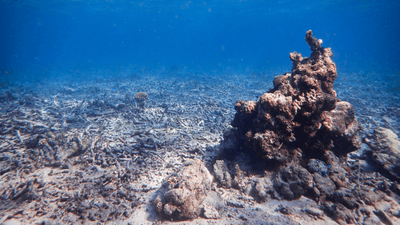
The results provide a harrowing insight into the regularity of this destructive fishing practice. A story that's perhaps best told in a series of recordings that demonstrate how one bomb can silence an ecosystem (see below).
Out with a bang
Bomb fishing, also known as blast fishing, involves throwing an explosive into a body of water. The subsequent shock kills any fish in the vicinity, providing a quick harvest, but it also destroys the underwater landscape.
Coral reefs account for less than 1 percent of the ocean floor, and yet they support over 25 percent of marine species. Their health is the foundation on which entire food webs are established, but all it takes is one bomb to wipe them out.
According to marine biologist Dr Ben Williams, who works for University College London and the Institute of Zoology, it can take decades for fish populations to recover after bomb fishing. The knock-on effect can leave fishing communities increasingly vulnerable, and, while bans are in place, they’re very difficult to enforce.
Ocean soundscapes
A first step towards tackling bomb fishing is to establish a reliable method of detecting when and where it’s being used. A team of British and Indonesian scientists set out to do just that by placing underwater microphones throughout the Spermonde Archipelago, Indonesia.
Those microphones picked up the symphony made by a healthy coral reef, as well as the sounds of bomb detonations over an area of at least 900 square kilometers (350 square miles). The researchers estimate this area contains just over 100 square kilometers (38 square miles) of reef.
After making the recordings, the team used a machine learning algorithm to identify bomb fishing events, with eye-watering results. The microphones recorded 3,570 bombs across 3,650 hours of audio. Scaled across a full year, that's equivalent to bombs being dropped 8,500 times, or once every 62 minutes.
Assuming these bombs were all dropped over reefs (which the researchers can't tell from microphone data alone), this level of bombing could amount to as much as 0.17 square kilometers (7 acres) of destroyed coral reef per year. Over three years, that's comparable to the size of Vatican City.
It’s a devastating find, but one the researchers say paves the way for action. By identifying where this activity takes place most frequently, conservationists and local communities can start to work together to find sustainable alternatives that will benefit people as well as wildlife.
“Given the advances we've shown are possible with this technology, I believe the bigger challenge now lies in introducing alternative livelihood campaigns,” said Williams to IFLScience.
“Sustainable fishing is an immediate option, but tourism has also proved successful in tackling other illegal practices, such as poaching, and holds great potential for coral reefs. When ecosystems are properly valued and their conservation funded, people who once exploited wildlife, including bomb fishers, have gone on to build careers protecting and restoring them.”
Thoughtful action, powerful results
Researchers, including the group behind this 2021 paper, have found that conservation efforts are more effective when they are managed by local communities. It can be a complicated process finding sustainable alternatives that are also economically viable, but when we get it right, the results can be remarkable.
Within just a handful of years the coral cover on these sites can return from less than 5 percent to over 80 percent
Ben Williams
“This archipelago is in fact home to the flagship site of the world's largest coral reef restoration program (buildingcoral.com), led by [the chocolate company] Mars,” said William. “This approach plants large carpets of steel 'reef stars' coated in reef sand to stabilize the rubble fields left by bomb fishing.”
“Fifteen coral fragments from nearby healthy reefs are attached to each of these. Within just a handful of years, the coral cover on these sites can return from less than 5 percent to over 80 percent.”

Williams says while the results are astonishing, this kind of restoration isn’t cheap, so it remains important to address the cause rather than the symptoms of reef destruction.
There's a big task ahead, but given the chance, the ocean has proven time and again that it can bounce back to the benefit of wildlife, people, and the planet.
The study is published in the journal Remote Sensing in Ecology and Conservation.



 1
1