Space and Physics
 PUBLISHED


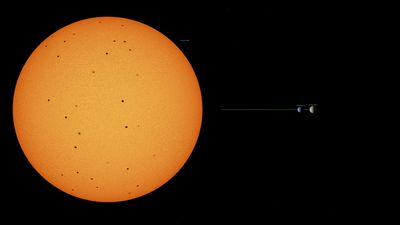


A planet orbiting the star GJ 887 may be the closest object to Earth with good prospects for supporting life, although confirming that will not be easy. The newly discovered “super-Earth” with a mass more than six time’s Earth’s should have tropical temperatures. GJ 887’s low flare activity means the chances of a substantial atmosphere are much better than for planets close to most red dwarfs.
The search for life beyond the Solar System is currently dominated by the search for liquid water, or at least conditions that could support water. References to “habitable zones” around stars mean places not too hot or cold for water to exist at the surface. However, water also needs an atmosphere if it is not to instantly boil away, and many habitable zone planets are suspected not to have one.
A newly announced planet orbiting in the habitable zone of the star GJ 887 has much better prospects than most of having retained an atmosphere, and therefore being within a true habitable zone.
Also known as Gliese 887, HD 217987, and Lacaille 9352, GJ 887 is the 16th closest star to the Sun, and the eighth closest solo star, 10.7 light-years away. In 2020, two planets were found orbiting GJ 887, but both are too close – and therefore too hot – to support liquid water.
That discovery was important, since such nearby planets might provide opportunities for study that more distant ones don’t, but the paper reporting them also revealed signs of a third planet, which if real would receive only slightly more incoming heat than Earth. At the time, the authors said the observations could be equally easily explained by a habitable zone planet or more boring distortions to the signal.
Naturally, such a question could not be left to rest, and five more years of observations have now confirmed the planet is real, with an orbit lasting 50.7 days. Although that’s even shorter than Mercury’s, GJ 887 has just half the Sun’s mass and less than 4 percent of its luminosity, so temperatures should be only moderately hotter than Earth’s, although a strong greenhouse effect might change that.
Low-mass stars often emit a lot flares, which are thought to strip any nearby planets of their atmospheres. Although some escape clauses have been proposed, this is why Proxima b, the nearest planet beyond our own system, probably doesn’t have an atmosphere and therefore any chance of life.
However, GJ 887 is an unusually calm star for its size, with none of these lethal flares. It’s possible this is just a temporary phase, and in a lifetime almost identical to the Sun’s it has sometimes been active enough to remove any planetary atmospheres, but the possibility the placidity is permanent is tantalizing.
Moreover, GJ 887 d, as the new discovery is named, has a mass at least 6.1 times that of the Earth. The extra gravity would be an obstacle to spaceflight, or possibly any flight at all, but it increases the prospects for hanging on to a cocooning layer of gas.
In fact, it is possible the gas is a little too thick, and that GJ 887 d is more of a mini-Neptune than giant counterpart of Earth.
Many of the planets that have excited astronomers the most cluster at around 40 light-years away. At a quarter of that distance, GJ 887 d has many advantages as a research target. Unfortunately, it also has one big drawback. Unlike most of the planets we have discovered, GJ 887 d does not transit across its star’s face as seen from Earth, thus preventing us from measuring the composition of its atmosphere, based on the way it filters its star’s light. It was discovered with the radial velocity method instead.
The distance to GJ 887 and the space between star and planet mean GJ 887 d will be right at the edge of detectability for the proposed Habitable Worlds Observatory. “GJ 887 is a compelling system for further study. It is a nearby and, hence, bright, M dwarf, hosting a minimum of four planets including a super-Earth-mass, Earth-mass, and potentially subEarth-mass planets. At least one of the planets is in the habitable zone,” the authors write.
The research also announces a fourth, previously unsuspected planet with a 4.4-day orbit, which would be ferociously hot, as well as an unconfirmed prospect with an orbit of half that. A separate study, published last year, raised the possibility of a giant planet much farther from GJ 887.
The study is published open access in Astronomy and Astrophysics.
[H/T: Phys.org]