


 Space and Physics
 PUBLISHED
 2
2


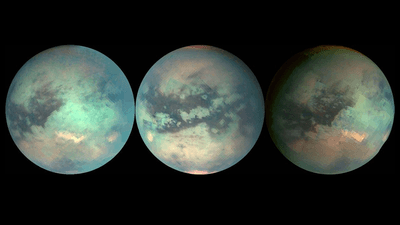


A proposed path for life to form on Titan appears to be closed by experiments on how compounds behave under conditions similar to those on Saturn’s largest moon. The work cannot test every potential chemistry for life, but by refuting one that some people have put their hopes in, it could redirect the focus of the future Dragonfly mission to explore the intriguing moon.
As the only moon in the Solar System with a thick atmosphere, and arguably the closest surviving counterpart to the early Earth, Titan has long been the focus of interest as a place life might be found. Although the chances are considered to be low, the possibility of hitting the jackpot in terms of finding extraterrestrial life is one reason NASA is sending a spacecraft to Titan, rather than the many worlds with strong competing claims.
According to work published in 2015, in a liquid methane environment, acrylonitrile (CH2CHCN) and larger molecules containing it (acrylonitriles) can form structures known as azotosomes that parallel the membranes that are essential to every living cell on Earth.
All three elements that make up acrylonitrile are abundant on Titan, and the molecule’s unique spectra have been detected in the atmosphere. The idea is that in that moon’s liquid methane lakes, azotosomes could create safe spaces for complex chemistry, while absorbing materials from the wider environment and disposing of waste when necessary.
Here, it was argued, is a way that life could evolve without liquid water, but new work indicates that’s unlikely. When Dr Tuan Vu and Dr Robert Hodyss of the California Institute of Technology explored the behavior of acrylonitrile in liquid methane, they could not get them to form azotosomes. Titan’s lakes contain varying mixtures of liquid methane and ethane, so the authors tried working with acrylonitriles in ethane as well. The results were even worse – not only could they not get the desired result, this time it was because acrylonitrile-ethane co-crystals formed instead.
“Ethane, hence, is gradually establishing itself to be more than just a solvent but an active participant in chemical processes even at cryogenic temperatures,” Vu and Hodyss write. Acrylonitriles exposed to ethane, even in predominantly methane lakes, would crystallize, preventing any azotosome formation and leaving no way to hold cells together.
It’s all very well for science fiction writers such as Sheri S. Tepper to play with the idea of intelligent living crystals, but much harder for scientists to see how essential features of life, such as self-assembly and reproduction, could take place.
The “habitable zone” around stars is usually defined as the area where liquid water could exist on a planet’s surface, although some narrower definitions also have support. This leads many outside the astrobiological community to question what is so special about water; just because we need it, doesn’t mean everyone else must.
However, many of the activities usually seen as essential to life depend on the capacity of liquids to transport molecules in ways solids and gases can’t. Although other liquids, including those that can exist at temperatures hotter or colder than water, might fulfill the equivalent role, those that have been investigated keep failing in crucial ways. It seems we can add liquid ethane to that list.
Even before Vu and Hodyss’s work, the capacity of acrylonitriles to form azotosomes on Titan had been questioned, with competing computer models giving conflicting results. To settle this, the authors conducted experiments at temperatures starting at 94 K (-178°C, -288°F)
Acrylonitrile and similar molecules would be an ironic basis for life. Its cyanide group makes it toxic even in quite small doses, and plastics made from acrylonitrile are a major ocean pollutant.
The study is published open access in Science Advances.


