Nature
 PUBLISHED


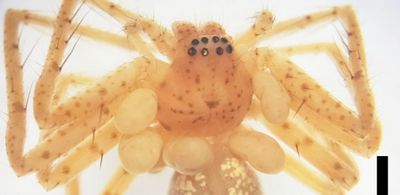


Take a closer look at a museum collection and you never know what might be hiding in the cabinets. For a group of researchers in Brazil it looked like one of their spider specimens was wearing a belt or a necklace of pearls – however, the truth is much, much more gross than that.
At the Zoological Collections Laboratory of the Butantan Institute in São Paulo, Brazil, researchers found a spider that was only a few millimeters long. The orangey red body of the spider was surrounded by small pearly white blobs.
On closer inspection, these pearly white blobs were revealed to be parasitic spider mites that had burrowed their faces into the spider's body to get to the hemolymph, the spider equivalent of blood. These are just the larvae though, as the adults grow up to be free-living in the soil.
The larvae themselves only measure half a millimeter long. Though tiny, this represents a remarkable (though quite gross) discovery. The mites belongs to a genus that had only been described in Costa Rica in 2017, suggesting that they could have a much wider distribution that previously known.
“For this group of mites, it isn’t uncommon to know many parasitic species only through their larvae, since in adulthood they become free-living predators, living in the soil and feeding on small insects and even other mites, which makes them very difficult to find,” said Ricardo Bassini-Silva, a researcher and curator at the Zoological Collections Laboratory of the Butantan Institute in São Paulo, Brazil in a statement.
Despite the 3,000 species of spiders living in Brazil, only one other spider-parasitic mite had ever been discovered and it belonged to a completely different family to the newly discovered white pearly larvae. The mite has been named Araneothrombium brasiliensis, meaning “from Brazil”. The larvae were found buried into the cephalothorax of the spider, which represents the most vulnerable point, less protected by the tough chitin that covers the rest of the body.
“This is the spider’s most vulnerable region since other parts have a lot of chitin, which forms an exoskeleton difficult for the mites‘ fangs to penetrate,” said Bassini-Silva
The team even think that the mites are especially targeting young spiders to feed on, and that more research could be done to understand their ecology and even discover more species of spider mites.
“With more than 3,000 species of spiders alone, Brazil has immense potential for discovering new parasitic mites,” says Bassini-Silva.
The study is published in the International Journal of Acarology.