Nature
 PUBLISHED
 6
6


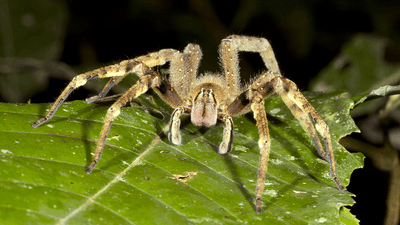


Meet the Brazilian wandering spiders in the genus Phoneutria, also referred to as the armed spiders or the banana spiders. The members of this group have one of the most dangerous bites of any spider species on Earth and they have been classified as the world’s most venomous spider many times.
Where Do Brazilian Wandering Spiders Live?
Though currently the Guinness World Record is shared with another species – the Sydney funnel-web, (Atrax robustus) – the Brazilian wandering spiders are a force to be reckoned with.
As the name suggests all the Brazilian wandering spiders can be found in northern South America, with at least one species having distributions across more than just Brazil, writes the University of Florida. However, Phoneutria fera and Phoneutria nigriventer are the main species that feature in news articles as they often travel overseas in shipments of bananas, causing panic and confusion – and even the closure of supermarkets.
What Is The Size Of A Brazilian Wandering Spider?
The size of the Brazilian wandering spiders varies between species. Some can be very large with a leg span of 18 centimeters (7.1 inches). The spiders are famously quite aggressive, and instead of running from threats will rear up onto their back legs and stand their ground.

What Are The Effects Of A Brazilian Wandering Spider Bite?
Brazilian wandering spiders often make the news because of the unusual symptoms caused to humans after being bitten by one.
A 2023 study in Frontiers In Molecular Biosciences suggested there were around 4,000 cases of people being bitten by Phoneutria nigriventer in Brazil each year. Their venom affects the nervous system, causing double vision, salvation, irregular heartbeat – and even prolonged painful erections, known as priapism. In fact, because of this, their venom is being explored as a possible treatment for erectile dysfunction conditions.
Can A Brazilian Wandering Spider Bite Kill You?
The neurotoxin PhTx3 is to blame for these symptoms, and according to the Independent, a wandering spider bite can reportedly be fatal in as little as 60 minutes. However, an effective anti-venom is usually enough to save those affected. A study into Phoneutria boliviensis in 2019 suggested that the species had adapted its venom to catch vertebrates as opposed to lizards and amphibians, which might explain why the venom is so toxic to humans.
It comes as no surprise then that their scientific name Phoneutria means “murderess” in Greek.