Nature
 PUBLISHED
 2
2


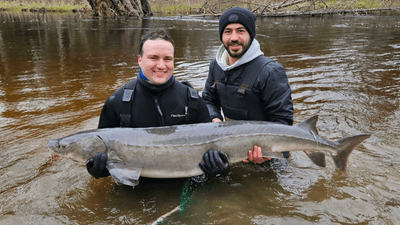


There’s a fish in North America that can grow to be as long and heavy as the tallest of humans. These lake monsters were thought to reach an incredible age of around 150 years. Only, we’ve just realized that number could be centuries off how long they really live.
“Scientists have long recognized that lake sturgeon are among North America’s longest-lived freshwater fish,” said Scott Colborne, assistant professor in Michigan State University’s Department of Fisheries and Wildlife, in a release emailed to IFLScience. “But the new study suggests they may live far longer than previously appreciated.
“These fish are a living connection to history.”
How do you age a fish?
That estimate of 150 years was based off of a 1963 study, but some questioned whether that number was typical for lake sturgeon or instead represented the extreme end of the scale. As such, it was generally assumed most sturgeon never reached that age.
The estimate was reached using fin-spine cross-section aging. It involves reading the layers of bone in the leading spine of their pectoral fin. While it’s a direct method, it doesn’t necessarily provide an accurate reading because resorption can lead to missing growth rings in the bone.
A new study sought to gain a more dynamic insight by using growth rate increments determined from capture-mark-recapture data. Essentially, catching fish, taking their measurements, and then catching them again. Over and over.
Big data, bigger results
This data was then fed into a model that could predict growth rate, how that rate slowed over time, and ultimately provide an estimated life expectancy of sturgeon from five Great Lakes populations.
It required decades of field work, but the findings were astounding.
The model revealed an age estimate of 90 to 279 years for a 160-centimeter (63-inch) male lake sturgeon. Meanwhile, the age for a 180-centimeter (70.8-inch) female ranged from 99 to 427 years.
Those figures put sturgeon in contention with Greenland sharks for the longest-living fish species known to science. For now, the Greenland shark maintains its title because we have dated actual tissue from these fish, meanwhile the sturgeon estimates are just that – estimates.
Further research is needed to establish is any sturgeon populations can rival or exceed the lifespan of Greenland sharks – thought to be around 400 years – but there is something else remarkable about the sturgeon findings.
Indigenous knowledge
The real “goosebump moment” for Colborne came when he spoke with a tribal community member involved in the long-term data collection. This person told him that Indigenous knowledge had long suggested that lake sturgeon could live for around 400 years.
“Here we were using modern analytical approaches, and they were pointing us toward something that Indigenous communities had long understood – that these fish live incredibly long lives,” said Colborne.
Colborne also notes that the research would not have been possible without the collaboration between university researchers, tribal nations, and state partners.
“It really highlights the importance of long-term conservation and monitoring,” he said. “Without people collecting these data over decades, we couldn’t answer questions like this.”
Protecting Earth's (old) giants
Understanding the true longevity of species is a critical detail for establishing effective conservation strategies. If a creature is living for centuries that tells us its life cycle is spread across vast time scales, and as such losing individuals before their prime could be devastating to a population’s survival.
As well as demonstrating the value of long-term conservation, monitoring, and research, it’s a reminder that human impacts could have consequences that span centuries. As such, we need to treat even Earth's lake monsters with considerable care.
The study is published in the journal Fish Biology.