Nature
 PUBLISHED


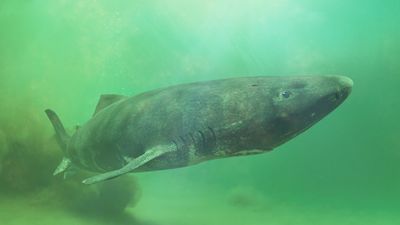


Researchers have identified two previously unreported genetic mechanisms that could help explain how Greenland sharks – mysterious denizens of the north Atlantic and Arctic Oceans – live so long, in a study published this week.
Greenland sharks are thought to be the longest-lived vertebrates on the planet, with radiocarbon dating suggesting they can reach 400 years old (though with a margin of error of around 100 years on either side). For context, that's significantly older than either the Galápagos tortoise or the bowhead whale, the latter of which lives for around 200 years.
The sharks are known for being able to endure temperatures as low as -1.1°C (30°F) and survive at depths of about 3,000 meters (9,843 feet). They also grow incredibly slowly, at a rate of about 1 centimeter per year, and take around 170 years to reach adulthood.
Because they live for such an exceptionally long time and reach lengths in excess of 6 meters (20 feet), the sharks should, statistically speaking, be riddled with cancer – yet they aren't, which suggests they must employ some clever genetic tricks to keep such diseases at bay.
Two previous studies have looked for answers by assembling the Greenland shark genome – a particularly difficult task because at 6.5 billion base pairs it is around twice as long as a human's and filled with repetitions – but despite this, the genetic basis for their incredible longevity remains poorly understood.
This inspired a team led by Shigeharu Kinoshita at the University of Tokyo to make their own attempt at piecing together the genome, a report of which was posted online as a preprint last year. Since then, the team has added two new findings and improved their genome assembly to cover 96.7 percent of the animal's DNA, making it the most complete to date.
The first of the new findings has to do with a protein called histone H1.0, which helps package DNA inside cells. The team identified several unique adaptations in this protein, including the substitution of an amino acid called lysine with another called arginine.
Both amino acids can be positively charged, which allows them to grab onto negatively charged DNA, essentially packing it up tight around the protein. But where lysine's charge can be turned off, arginine's can't. The authors suggest this may help the shark maintain its DNA in a tighter, more stable configuration that resists the kind of genomic disorganization that is a hallmark of aging in other vertebrates.
"We think the signals of positive selection in histone H1.0 are intriguing because they suggest that maintaining chromatin stability and protecting genome integrity may be especially important for extremely long-lived species such as the Greenland shark," Kinoshita told IFLScience. "Stable chromatin structure could help suppress the accumulation of cellular damage over very long periods of time."
The second new finding concerns ferroptosis, a form of cell death triggered by excess iron in the cell. The shark was found to carry 59 copies of a gene called FTH1b, which is connected with a protein called ferritin that keeps iron safely stored away.
This is far more copies than in any other shark the researchers examined, which they hypothesize gives Greenland sharks an unusually powerful ability to control when and whether their cells die in this way – potentially protecting healthy tissue while allowing damaged or cancerous cells to be eliminated.
"Since ferroptosis and oxidative stress are increasingly linked to aging and age-related diseases, this may indicate that tight control of iron homeostasis is another important mechanism supporting exceptional longevity," said Kinoshita.
The authors caution that both mechanisms remain hypothetical, since they can only infer function from the genome sequence itself; confirming what these genes actually do will require experiments in living cells.
The study is published in the Proceedings of the National Academy of Sciences.
Amendment (May 21, 2026): This article was updated to include quotes from Professor Shigeharu Kinoshita.