Nature



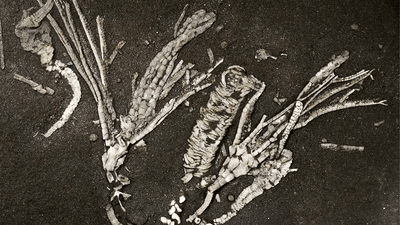


Soft tissue from a crinoid is offering paleontologists a direct look at some of Earth’s earliest coral reefs.
Of all the trillions of crinoids that have lived and died in our oceans, this is only the second time soft tissue has been found in one of their fossils, and it's comfortably the oldest.
The vast majority of known fossils are composed of bones, teeth or calcium carbonate shells. When we do get soft tissue, it's from the impression left in mud, rather than the tissue itself being preserved. That leaves great gaps in our knowledge of extinct creatures, but some scientists persevere.
“After an animal dies, soft tissues like skin, eyes, or internal organs are the first things to decay,” said Dr Lena Cole of Oklahoma University, in a statement. “Most fossils are only made up of hard parts like bones, teeth, or shells."
"Soft tissues are only preserved when the environment acts almost like a natural refrigerator or vacuum‑sealer - conditions that are incredibly rare.”
There are exceptions, like dinosaur skin that evokes awe, but examples from the Ordovician are not only up to 7 times older, but they also give us an insight into an ecosystem we know considerably less about.
So when Cole and colleague Dr David Wright found fossilized tube feet of the crinoid Dendrocrinus simcoensis in a specimen at Montréal’s Musée de paléontologie et de l’évolution, they knew they had something special.
The museum runs on community donations and lacks in-house specialists to study the fossils, so the importance of a crinoid found near Quebec City was overlooked until Cole and Wright visited. Wright and Cole were actually the authors of the paper that first described D. simcoensis, along with three other new crinoids from the same era.
But first of all, what exactly is a crinoid?
Crinoids are echinoderms, the group best-known for including starfish. Modern crinoids include sea lilies and feather stars. The majority of their body is made of calcareous plates that fossilize well, and actually these make up a large component of some limestone beds.
However, these hard parts can only tell us so much, with the smaller soft parts such as their tube feet vital to understanding their ecology.
To a crinoid, a tube foot is not something they stand on, but what they use to capture plankton. As they crinoids wave their fans through the water, particles of plankton are stuffed by trios of tube feet into grooves to be drawn down to the mouth.
Evolutionary pressure has created diversity in size, shape, and spacing of the tube feet depending on the crinoid's specific ecological niche.
“Since crinoid tube feet are used for feeding, you can think of them in a similar way to how we think about teeth in mammals,” said Wright. “Differences in their structure tell us about what kinds of environments a species lived in and how it fed.”
The shape and arrangement of the fossil’s tube feet falls within the range of modern crinoids, but no known living species’ combination of features matches those of D. simcoensis.
“Comparisons with living crinoids show that the anatomy of this ancient species was very different,” Cole added. “This gives us new insight into how crinoids evolved and how their feeding strategies changed over hundreds of millions of years.”
We may never know how these tube feet came to be preserved when so many others are not, but the authors write, “The soft tissues that make up the tube feet are preserved as slightly raised, lightly pyritized structures, whereas biomineralized skeletal elements of the crinoid are preserved as calcite.”
“Preservation like this is truly one in a million,” Cole said. “Crinoid fossils number in the millions, and this is only the second time soft tissues have ever been found.”
When you think of all the crinoids that didn’t fossilize, the odds against a tube foot being preserved are much higher still.
“This discovery highlights the importance of museum collections and the community support that keeps them alive,” Cole said. “Without the dedication of many people caring for these collections, this research would never have been possible.”
“This is why we work to make our collections accessible to researchers around the world,” Wright added. "There are simply too many fossils to study over one person’s career. There’s more than a lifetime’s worth of discoveries waiting to be found.”
The study is open access in Royal Society Open Science