Nature
 PUBLISHED


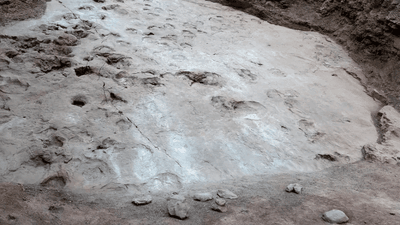


An ancient trail of tiny dinosaur footprints has been discovered in the Linxia UNESCO Global Geopark in Gansu province, China. According to reports from South China Morning Post, scientists got the heads up from museum employees in the region who spotted the miniature marks after heavy rains.
Extreme weather can both help and hamper paleontology. On the one hand, the sped-up erosion can bring to the surface things that have been buried over time. However, as the discovery of possibly the oldest dinosaur to date recently demonstrated, it can also make the process of studying such finds much, much harder.
In the case of these miniature footprints, the rains revealed five that are said to be just a few centimeters across, demonstrating how small the dinosaurs that made them were. It’s thought that Minisauripus may be behind the prints, thought to be a little smaller than a chicken.
“We estimate that the body length [of the dinosaurs] is about 25 centimeters (9.84 inches), but the tail should account for at least half of the length,” said Lida Xing, a paleontologist and associate professor at the China University of Geosciences, to SCMP.
As Xing explained, while we might think most of the mightiest of dinosaurs, the mini ones were an important step to the enormously successful animal group that came next: “The miniaturisation of dinosaurs was a key factor in their evolution into birds, and it was a very important evolutionary event.”
If the fossil footprints do indeed belong to Minisauripus, it appears they may have been living alongside waterbirds, as evidenced by other footprints and ripple marks that indicate water was nearby. Being so small means these dinosaurs leave little in the way of fossils for scientists to study, which is why ichnology is so important as it enables us to study their fossilized tracks in lieu of bones.
There’s some debate as to whether the fossil evidence we have for these dinosaurs is their adult or juvenile form, but in a 2016 paper Xing and colleagues wrote that some Minisauripus prints in Yangmozu in Sichuan Province were “the smallest known non-avialian theropod track ichnogenus.”
So, a diddy dino indeed.