Nature
 PUBLISHED
 1
1




Three and a half billion years ago life had not only found a way, but diversified, so that all these years later we can observe differences in what was left behind.
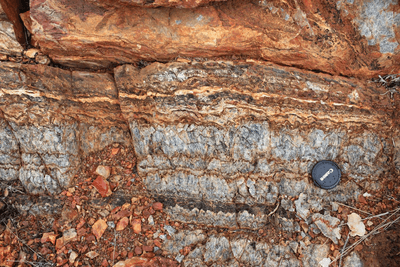
The Earth has undergone so many cycles of geologic uplift and destruction that there is very little left of the rocks from the time when life had just begun. Parts of Western Australia represent one of the few exceptions, holding traces of microorganisms 3.48 billion years old.
Barite is a particularly promising material to study from this time, since it is stable under high temperature and pressure conditions, and does not dissolve easily in water.
Black bedded barite samples analyzed by University of Göttingen PhD student Lena Weimann and colleagues come from calderas, hollows that form after volcanic eruptions and often fill with lakes. Hot fluids in the caldera provide both energy and nutrients to lifeforms today, and such environments are good candidates for the places where life first evolved. Trapped in the barite, the team found carbonaceous particles whose molecular size indicates they were left behind by early lifeforms.
“As our findings show, original traces of the first organisms can still be found even from extremely old material,” Weimann said in a statement.

Not a lot of information about these organisms has survived, although we know they must have been single-celled. That might suggest there is little we can learn. However, when Weimann’s team combined several high-resolution observation techniques they found three distinct sorts, which they call populations, of carbonaceous material.
These indicate that the life forms of the day had evolved to fill separate niches even at this early point in time.
The most common population is found at the edges of single growth bands of barite crystals. A second is found finely distributed within the barite matrix, while the third is found within quartz veins that crisscross the barite. The first two were apparently deposited as the barite crystallized, while the quartz apparently entered the system at least 200 million years later, accompanied by the third population.
The team thinks population one arises from organic particles accumulating on crystal surfaces where the water and sediment met. When the flow of hydrothermal fluid dropped off or temperatures fell, biofilms and microbial mats, like those formed by single-celled organisms today, sometimes became incorporated into the rocks.
When the flow picked up, particles that may have been from organisms living elsewhere were carried with it. Crystallization rates were higher at these times, and the particles got distributed within the growing crystals, creating population two.
The study is published open access in Precambrian Research.