Nature
 PUBLISHED


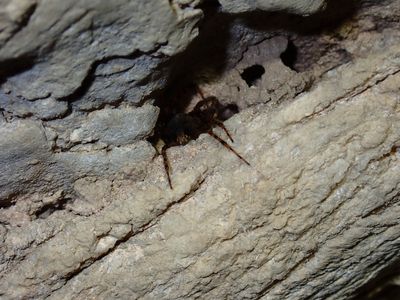


There are some pretty weird relationships in the animal world. Some parasites exist only in the eyes of the world’s oldest sharks, while researchers have been researching fungus that survives by infecting spiders. Now, a new species of such a fungus has been described altering the behavior of its spider host, in the same style as zombie ants.
The Gibellula genus describes a group of fungi that are pathogenic to spiders. During a showing of the BBC nature program Winterwatch in 2021, a fungus-infected spider was discovered on the ceiling of a disused gunpowder store in Northern Ireland. Subsequently, identification of the spider revealed it was a species of orb weaver called Metellina merianae. The fungus was thought to belong to the Gibellula genus and further research revealed the new species. Other samples of spider species called Meta menardi collected in Ireland were also sent for analysis.
“Subsequently, the spider host was identified as the orb-weaving cave spider, Metellina merianae, and – through the help of a local speleologist – further specimens of the new species, Gibellula attenboroughii, were found in cave systems in both Northern Ireland and the Republic of Ireland, as well as on a related spider, Meta menardi, occupying different ecological niches within the caves,” Dr Harry Evans, author of the study, told Science News.
The new species was named Gibellula attenboroughii sp. nov. after the natural history broadcaster Sir David Attenborough. The team believes that this species can manipulate the spider's behavior. Typically, Metellina merianae spend time in their lairs within caves or human-made structures like cellars. All the infected spiders had moved from their hiding spots and were found in the open areas on cave walls or ceilings. The researchers suggest that the fungus manipulates the spiders into traveling to more exposed areas, thus allowing air currents within the space to spread its spores.
While the mechanism of how the fungus changes the spider's behavior isn’t fully clear, it could be related to dopamine seen in the “zombie ants” infected with Cordyceps fungus. Popular media has seen the rise of fungus-inspired zombie disaster movies and video games with The Last Of Us leaving us wondering if a fungi-based world event should be on our 2025 disaster bingo card.
The paper is published in Fungal Systematics and Evolution.