Humans
 PUBLISHED

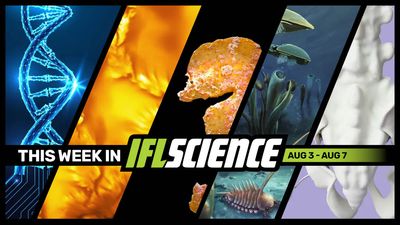


This week, the highest resolution images of the Sun’s surface yet could help explain explosive solar activity, these sea Muppets are a mysterious new marine species that have never been seen alive, and while male pelvises have continued to evolve, women appear to have the same pelvic structure as Neanderthals. Finally, we investigate the living magnet bacteria that use the Earth’s magnetic field for navigation.
Create an IFLScience account to get all the biggest science news delivered straight to your inbox every Wednesday and Saturday.
In A World First, Scientists Used AI To Generate A Genome And Produced A Functional, Bacteria-Killing Virus
It's a story that could have been lifted straight from a sci-fi screenplay. Scientists use generative AI – technology whose power humanity is just starting to understand – to write a whole new genetic code, and use it to create functional designer viruses. The viruses in question are bacteriophages, which only infect bacteria – they can’t infect humans, or any other animals for that matter. But applications still have the potential to impact human society in a big way. Read the full story here
Highest Resolution Images Of The Sun’s Surface Reveal Vortices That Could Explain Explosive Solar Activity
Swirling patterns on the Sun's surface may explain why our star's magnetic field lines have a tendency to tangle and reconnect, producing powerful solar storms that cause auroras and other atmospheric phenomena here on Earth. Read the full story here
"You Can't Unsee The Muppet Show" – Meet The Sea Muppets, Mysterious New Species That Have Never Been Seen Alive
Surprising things can lurk in museum drawers. In a literal case of mistaken identity, a curious set of museum specimens has led to the discovery of a whole new genus for the Syngnathidae family tree. And they're named after the Muppets. Read the full story here
How “A Little Bowel Movement” 540 Million Years Ago Sparked An Evolutionary Explosion, Changing The Face Of Earth Forever
If we're going to figure out how the planet might react in response to big environmental changes, it's important to figure out what drove big changes in the past. It's a quest for knowledge that recently raised an interesting question: Have you ever thought about a world before poo? Read the full story here
Men Evolved A Unique Pelvis That Puts A Spring In Their Step, But Women Have The Same Pelvis As Neanderthals
Modern human males are uniquely adapted for long-distance walking thanks to a specially altered pelvis not shared by prehistoric hominins. Women, however, did not evolve this particular mechanism, and possess a more ancestral pelvis that is strikingly similar to that of male Neanderthals. Read the full story here
TWIS is published weekly on our Linkedin page, join us there for even more content.
Feature of the week:
Living Magnets: Meet the Bacteria That Can Sense Earth's Magnetic Field
Living things have a startling array of senses, and one of the most mysterious is the ability to navigate using magnetic fields. Like having their own internal compass, birds do it, and so (we think) do bees, but did you know some bacteria can manage it too? Read the full story here
More content:
Have you seen our e-magazine, CURIOUS? Issue 49, August 2026, is available now. This month, we asked, “How Do Animals Get Their Patterns?” – check it out for exclusive interviews, book excerpts, long reads, and more.
PLUS, the We Have Questions podcast – an audio version of our coveted CURIOUS e-magazine column – continues. In episode 23, we ask, “Why Do 8 Million Pickled Fish Sit In Louisiana's WWII Bunkers?”
The Big Questions podcast is back for season 6! In episode 4, we ask “Are ‘Natural Disasters’ On The Rise?” Host Dr Russell Moul sat down with Dr Samantha Montano, a disasterologist and emergency management expert, who has seen taxonomy from the other side, to ask about the ways in which disasters are changing and how societies respond to them.