Nature
 PUBLISHED






What you’ll discover in this article
- Hidden in the sediment beneath rivers, ponds, and swamps around the world are bacteria with a superpower: they always swim towards magnetic north.
- Why bacteria would behave like this isn't immediately obvious, but it appears to help them find the right environment in which to divide and thrive.
- Remarkably, these magnetic marvels have even more tricks up their proverbial sleeves, with some being the only known bacteria that must form a multicellular structure to survive.
Living things have a startling array of senses, and one of the most mysterious is the ability to navigate using magnetic fields. Like having their own internal compass, birds do it, and so (we think) do bees, but did you know some bacteria can manage it too?
On the one hand, you might expect that would be the case. Bacteria have been around for yonks, after all. In that time they've solved a host of arguably more difficult problems, including how to harvest the sun's energy and survive at least 5 kilometers (3 miles) beneath Earth's surface.
They swim up out of the sediment to that pellet there, and then you can just pipette them out. Anyone with a magnet and a jar can do it.
George Schaible
But from another point of view, it's really quite a weird ability for them to have. Birds and bees use magnetism to navigate over large distances, yet bacteria are microscopic.
From their perspective, Earth's magnetic field barely changes no matter which direction they travel in, so what use do they have for a compass?
Meet the magnetic microorganisms
Magnetotactic bacteria, as they've come to be known, first turned up in 1963 in a sample of fresh water collected by Italian scientist Salvatore Bellini. He noticed some bacteria under his microscope consistently moving in one direction, and when he checked their movement against a compass, he found they were heading inexorably north.
Bellini hypothesized that these bacteria must contain a structure analogous to his compass needle, but he didn't pursue the idea and never published his findings in a journal.
It wasn't until 1975, when the phenomenon was rediscovered at Woods Hole Oceanographic Institute in Massachusetts, that we learned these unusual bacteria contain tiny crystals that line up along Earth's magnetic field.
In other words, they genuinely possess something remarkably like a miniature compass needle.
Depending on the species – and there are many of them out there – these crystals are either made of iron oxide (Fe3O4) or iron sulfite (Fe3S4), and they are each wrapped in a layer of fatty molecules, forming a roundish structure called a magnetosome.
Each bacterium has a few tens of magnetosomes, and they are almost always laid out in a rigid chain along the long axis of the bacterium.
This chain arrangement maximizes the magnetic dipole moment, or the amount of torque the bacterium experiences when it's misaligned with the magnetic field. The greater the torque, the more the bacterium is pulled into alignment, and so the long chains of magnetic crystals make the bacterium more efficient at orienting itself towards the magnetic pole.
To be clear, the bacteria aren't pulled towards the pole by the magnetic crystal, it just gets them pointing in the right direction. They move because each has at least one corkscrew tail, called a flagellum, that sticks out the back of the organism and spins like a propeller, either clockwise or anti-clockwise, causing it to travel forwards or backwards.
"So that's how the cells are responding," George Schaible at the University of California Santa Barbara told IFLScience. "You're passively orientating them and then they're just beating their flagella and swimming."
Incidentally, this is another bacterial invention – the only known rotating mechanism of locomotion with an axle and shaft in the tree of life. It even has gearing. And the tiny life-forms got to the idea billions of years before humans invented the wheel.
Reasons for attraction
So now we know how the little swimmers head north, but what good does that do them? Well, no good at all actually. It's hard to imagine a scenario where always travelling north would give you any benefit.
The real kicker is that, unless you are exactly at the equator, Earth's magnetic field has a vertical incline. This means, in addition to knowing which way is north, magnetotactic bacteria also know their up from their down.
This is useful because the bacteria live in sediment, often below stagnant water. This is a vertically stratified environment where travelling up and down makes a big difference to the kinds of molecules you encounter in your surroundings, particularly the concentration of oxygen.
Magnetotactic bacteria are Goldilocks creatures when it comes to oxygen, and they need that concentration to be just right.
"They're micro-aerophilic," said Schaible. "They can tolerate oxygen, but in high oxygen concentrations they can only live for maybe like 20 to 60 minutes."
Most oxygen-sensing bacteria use a system that compares the amount of oxygen at one point in time with its concentration at the next point in time. From this information, they adjust the rotation of their flagellar motors to move either closer or further away, depending on their needs.
That's all well and good, but such a mechanism is prone to wild goose chases. For example, eddies in the water might temporarily increase the concentration of oxygen towards the left or right. This is where the magnetism can come in.
Working out the vertical axis with magnetism allows the bacterium to just keep swimming down or up, reducing a three-dimensional search problem to a single dimension, presumably saving time and energy.
It's a neat trick that likely makes these magnetic marvels more competitive, and it may account for why you can find them across stratified sediments all around the world.
And find them you can. Since they are magnetic, it's actually very easy to isolate magnetotactic bacteria from samples of pond sediment using little more than a magnet and a plastic container.
Just fill the container with a mix of sediment and water, strap a magnet to the side about halfway up, and, after a few hours to a few days, you should see a grey streak has formed on the side of the glass.
"They swim up out of the sediment to that pellet there, and then you can just pipette them out," said Schaible. “Anyone with a magnet and a jar can do it.”
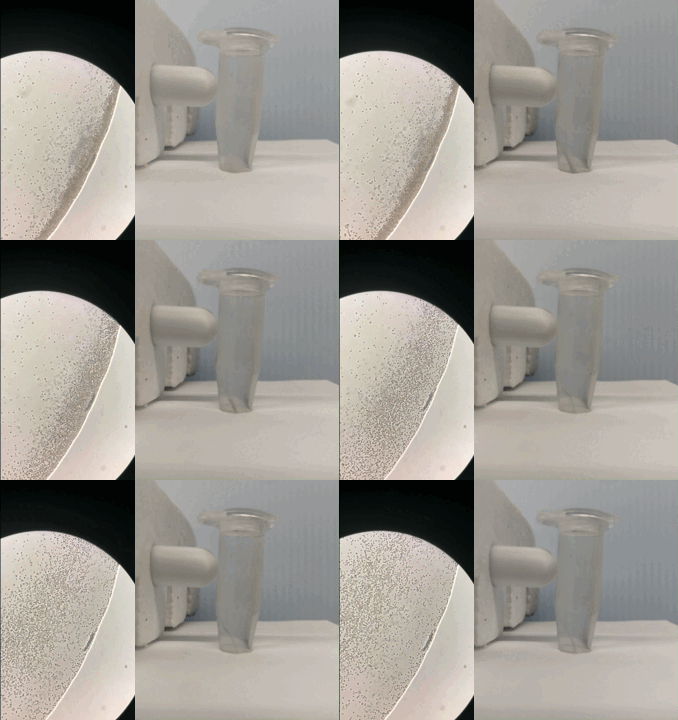
Once you've slurped up the streak you can mount it on a microscope slide, where, given enough magnification and resolution, you should be able to spot the bacteria swimming around.
You can even mess with them by moving that magnet from one side to the other, as these darn-tootin' researchers did.
Working as one
What's most remarkable is that these magnetic abilities aren't even the strangest thing about magnetotactic bacteria. They are also one of the few kinds of bacteria that sometimes group together and work as a team.
Some of these multicellular magnetotactic bacteria (MMBs) can’t even live as individual cells, making them the only known bacteria that must live multicellular lives to survive.
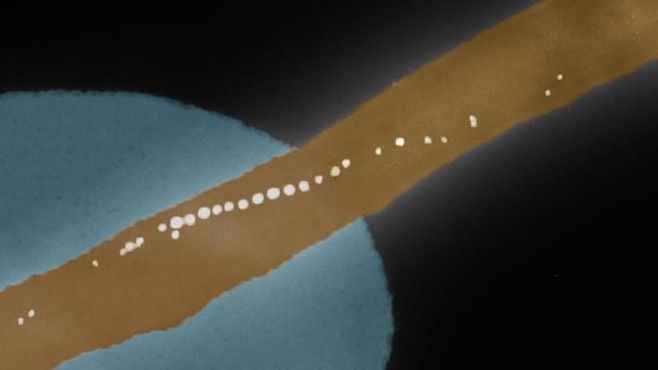
MMBs form hollow spheres made from a single layer of bacterial cells, with their flagella facing outwards. They can respond to magnetic fields within fractions of a second, implying some kind of communication between the cells that allows them to coordinate their movement.
During his PhD, Schaible and his colleagues found that the cells are genetically and metabolically distinct from one another, and their behavior is complementary – each cell has a role that contributes to the survival of the group.
It isn't yet clear why these two unusual properties are shared by one kind of bacteria, said Schaible.
“Maybe it [began as] just a layer of single cells that swam together. Or potentially it was like clonal division, where they divided and then just stuck together," he said.
Co-opting magnetic bacteria
While there has been no documented example of magnetotaxis arising de novo in a eukaryotic, or complex, cell – the type you and I are made of – there are some that have hijacked the ability.
In July this year, a team reported the discovery of a single-celled eukaryote, called a ciliate, found in freshwater sediment of a jungle stream in Gabon that displayed magnetotactic behavior.
When it was examined under a microscope, researchers found numerous rod-shaped bacteria living inside the larger cell, each with a magnetite magnetosome chain.
"We were intrigued by the size of these organisms and wanted to know what they were and what makes them magnetic," Mitali Chitnis at the University of Munich told IFLScience.
"We particularly were excited to see the micrographs of the of magnetite crystals in a unique necklace-shaped arrangement inside of the ciliate."
The ciliate also contained another kind of single-celled organism, an archaean methanogen, resulting in a three-way symbiosis that benefits each of its members.
We know that some parts of eukaryotic cells, such as the mitochondria, are the result of a symbiotic relationship with bacteria, so who knows - perhaps we're seeing the start of an extraordinary relationship that could result in more magnetic species where we least expect them.