Nature
 PUBLISHED
 1
1


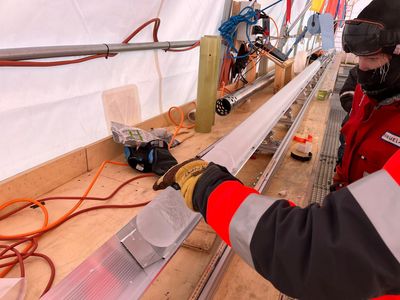


In the quest to find the world’s oldest ice, scientists have successfully drilled a 2,800-meter (9,186-foot) long ice core, reaching where the Antarctic ice sheet meets bedrock. The incredible feat reveals a continuous record of Earth’s climate that dates back at least 1.2 million years.
The ice core was obtained from a remote site in Antarctica called Little Dome C by researchers from the “Beyond EPICA - Oldest Ice” project, funded by the European Commission.
“The right location was identified using cutting-edge radio echo sounding technologies and ice flow modeling. Impressively, we found the record that goes from 0.8 to 1.2 million years ago, exactly where it was predicted to be, in the depth range between 2,426 and 2,490 meters [7,959 and 8,169 feet], extending our previous twenty-year-old EPICA ice core record,” Frank Wilhelms, principal investigator in the field and joint professor at Göttingen University and the Alfred Wegener Institute, said in a statement.
Antarctica is covered in extremely chunky ice sheets that sit on top of continental bedrock. The latest expedition by Beyond EPICA has reached the transition point between ice and rock, which could provide important clues about our planet’s past.
Ice cores can provide insights into Earth’s climate history because each layer captures atmospheric gases, dust, and isotopic compositions from the time it was formed, allowing scientists to infer past conditions.

“From preliminary analyses recorded at Little Dome C, we have a strong indication that the uppermost 2,480 meters [8,136 feet] contain a climate record that goes back to 1.2 million years in a high-resolution record where up to 13,000 years are compressed into one meter of ice”, explained Julien Westhoff, chief scientist in the field and postdoc at Copenhagen University.
Obtaining these samples is a mammoth task. In total, the team has been working for over 200 days in the central Antarctic plateau at an altitude of 3,200 meters (10,498 feet) above sea level where the average summer temperature is -35°C (-31°F).
Now, the project is tasked with the challenge of transporting the ice core samples back to labs where they can be properly studied.
“The precious ice cores extracted during this campaign will be transported back to Europe on board the icebreaker Laura Bassi, maintaining the -50°C [-58°F] cold chain, a significant challenge for the logistics of the project”, said Gianluca Bianchi Fasani, senior researcher at ENEA-UTA (National Agency for New Technologies, Energy, and Sustainable Economic Development - Antarctica Technical Unit) and head of ENEA logistics for Beyond EPICA.