Nature
 PUBLISHED


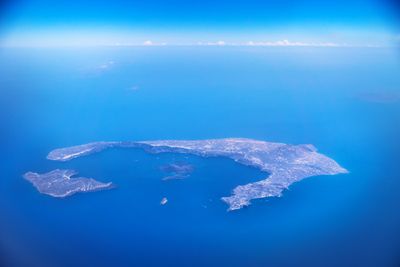


The Greek island of Santorini normally conjures up images of beautiful white buildings and dreamy blue seas, but since January this year, its home in the Aegean Sea has been hit by a near-constant string of seismic activity – so what’s going on?
At the time of publishing, in the last 24 hours alone, the University of Athens' Seismological Laboratory has detected 90 earthquakes with an epicenter in the Cyclades region containing Santorini, Amorgos, and Ios, one of which was above 5.0 magnitude.
That might sound like a lot of quakes, but they’re only the latest in a long line. On January 26, there were 26 earthquakes in the Cyclades region; since then, the total number of earthquakes has reportedly reached more than 12,800. Some days in February have seen more than 1,000 earthquakes per day, and though at one point their strength appeared to be decreasing, the island was hit by a shallow, 5.3 magnitude quake on February 10.
As a result of the tremors, a state of emergency has been declared on Santorini (and Amorgos), with thousands of residents choosing to leave the island.
What’s causing the earthquakes?
Santorini is no stranger to geological unrest – the island is volcanic and is still considered to be active, despite no significant eruption since the 1950s. While seismic activity can indicate a coming eruption, seismologists have said volcanic activity is not to blame for the recent earthquakes.
“Although the observed seismicity occurs within the active volcanic arc of the South Aegean, it is not directly related to any known volcanic center,” said the University of Athens Seismological Laboratory in a translated press release.
Instead, experts from the lab explained that the activity seen “so far probably bears the characteristics of a seismic swarm, as no earthquake with a magnitude clearly larger than all the others, which could be characterized as a main earthquake, is discernible.”
“Seismic swarm” refers to a series of relatively small earthquakes that often occur within a short space of time and in the same place, with no identifiable “mainshock”.
The swarm near Santorini appears to be related to the activation of a system of normal faults, fractures in the Earth’s crust where there is movement. Earthquakes are the result of a sudden release of tension built up by the movement along these faults.
“Seismic swarms, especially those located in or near volcanic environments, are often triggered by fluid intrusion into the ruptured tissue, which facilitates ruptures, in combination with stress transport caused by the tectonic earthquakes themselves,” explained the University of Athens Seismological Laboratory.
What isn’t clear is where the activity will go from here – there’s no accurate, reliable way to predict earthquakes. However, the experts from the seismological lab have made some suggestions as to what could happen.
“Although it is likely that this is a cluster that contains earthquakes of large magnitudes, compared to other recent seismic clusters in Greece, one possibility is that its activity will continue with gradually smaller magnitudes and a smaller number of earthquakes, but will last for many months,” they explained.
“However, a second possibility, which cannot be ruled out, is that this swarm stimulates the rupture of a significant part of a large active fault in the region, thus giving rise to a main earthquake, and then the activity takes the form of a typical post-seismic sequence.”
“We are monitoring not only seismographs but also numerous other systems that track ground deformation, gas emissions, and satellite data,” Costas Papazachos, professor of geophysics at the University of Thessaloniki, told ERT radio, The Associated Press reports. “At this moment, I can honestly say we do not have a definitive forecast, as it is too early to assess the current slight de-escalation of seismic activity. We have encountered many surprises.”
“Hopefully, this particular sequence will surprise us in a positive way and resolve itself sooner rather than later,” he said.
All “explainer” articles are confirmed by fact checkers to be correct at time of publishing. Text, images, and links may be edited, removed, or added to at a later date to keep information current.