Humans
 PUBLISHED




This week, a celestial event called an exosyzygy, which is so rare we've only seen it once before, looks set to happen again soon, the long debate surrounding Spinosaurus's aquatic lifestyle might be settled with a new funky species, the first ever footage of a shark in Antarctic waters has been captured, a longstanding conundrum at the heart of how animals, plants, and fungi evolved may have been solved, rock art carried out over 10,000 years has been found in the Egyptian desert, and scientists did not drink the oldest water on Earth, read on to find out why.
We’ve Only Seen A Pair Of Eclipsing Exoplanets Once Before – Astronomers Think It’s About To Happen Again
An incredible space event might be happening in the heavens, and it is likely that we are going to miss it. The Kepler-89 system is so far the only other place in the universe where we have seen a planetary alignment, where two exoplanets end up eclipsing each other as they pass in front of their star. This means that four celestial bodies – Earth, the star Kepler-89 A, and two of its four planets – will all be on a single line. The team that saw it the first time thinks it's about to happen again but trying to get time on telescopes is proving hard. Read the full story here.
Marvelous New Spinosaurus Species Could Settle Great Debate About Its Lifestyle And Inspire A Nation
A new species of Spinosaurus with spectacular headgear has been described, and the location where it was found is powerful evidence in a closely followed dinosaur debate: Were these giants sea creatures or partially aquatic? For such a rich prize, palaeontologists had to search in a war-torn region of the world’s largest desert, and have found a way to give back to the locals. Read the full story here
This Is The First Shark Ever Filmed In Antarctic Waters – "One Of Those True Wonders Of Nature"
For the first time, a shark has been filmed in the near-freezing waters of Antarctica. Its shock appearance came as a pleasant surprise to scientists as they had no idea sleeper sharks inhabited the waters – and it goes to show how little we still know about our planet’s own oceans. Read the full story here
A Major Conundrum In The Origin Of Complex Life Has Just Been Solved
Researchers investigating the origin of complex life on Earth appear to have solved a longstanding mystery at the heart of how animals, plants, and fungi evolved. Complex cells are thought to be the result of a union between two ancient microorganisms, but scientists have long been stumped over how this unlikely pair came together. Read the full story here
Up To 10,000 Years Of Rock Art Found Scrawled At Rock Shelter In The Egyptian Desert
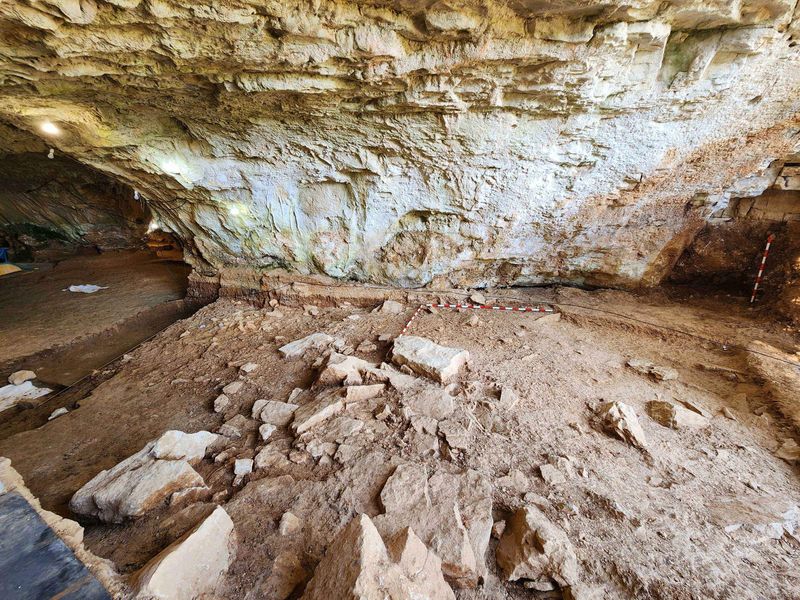
For many thousands of years, people returned again and again to this remote desert outcrop, leaving their marks across its stone walls. It’s unclear why this site became so prolifically adorned in illustrations, but the evidence of human activity over long periods of history suggests it held deep and lasting significance for many different cultures. Read the full story here
TWIS is published weekly on our Linkedin page, join us there for even more content.
Feature of the week:
Geologists Found The World’s Oldest Water. Did They Drink It? No, Here’s Why
In 2013, deep within a Canadian mine, geologists discovered a fracture that contained the oldest known water on Earth. Hidden nearly 3 kilometers (1.8 miles) below the surface, the ancient water had been sealed away for around 2.64 billion years. The site was an ideal place to search for ancient geological history because its layers of volcanic and sedimentary rock have remained relatively undisturbed by erosion and seismic activity, neatly preserving a record that stretches back billions of years. Was the water drinkable? We spoke to one of the team to find out. Read the full story here
More content:
Have you seen our e-magazine, CURIOUS? Issue 43, February 2026, is available now. This month, we asked, “Why Do We Need The Dark?” – check it out for exclusive interviews, book excerpts, long reads, and more.
PLUS, the We Have Questions podcast – an audio version of our coveted CURIOUS e-magazine column – continues. In episode 17, we ask, “How Can Swimming For 37 Hours Help Tackle Ocean Plastic?”
The Big Questions podcast season 5 has now concluded, but here’s one more bonus episode to help see you into 2026: Can Magic Be Used As A Tool In Science? You can catch up on the whole of season 5 here.