Humans
 PUBLISHED




What you'll discover in this article
- An extensive set of footprints discovered on the shores of Kenya's Lake Turkana may have belonged to a distant human relative, Paranthropus boisei, but they are unexpectedly huge.
- The foot size is closer to Homo erectus and could mean P. bosei had more in common with our direct ancestor than thought.
- Curiously, the tracks also suggest that large groups of males traveled together, hinting at complex social structures.
- We need more fossils to understand Paranthropus’s true size, lead author Dr Kevin Hatala told IFLScience. “A complete skeleton sure would be nice, but that's a lot to wish for!”
In a time when early humans co-existed with near relatives, a group of eight hominins walked along what was then a lakeshore. Their footprints indicate that either we have been wrong about the shape of our direct ancestors’ feet at the time, or their cousins Paranthropus had even more in common with us than had been thought. Either way, new research indicates that a capacity to get along with others of their own kind, and those of a different species, runs deeper in our ancestry than has been acknowledged.
One of the biggest revelations in paleoanthropology recently is that different species of hominin co-existed, sharing the same territory at the same time. This discovery, in stark contradiction to the linear account of our evolution from apes that prevailed for decades, provides a quite hopeful lesson on our capacity for live and let live, but it also makes for considerable confusion. After all, if two quite similar species overlapped, we might not know which one left a bone or footprint behind.
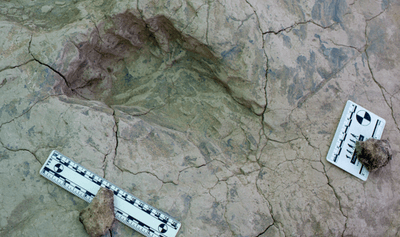
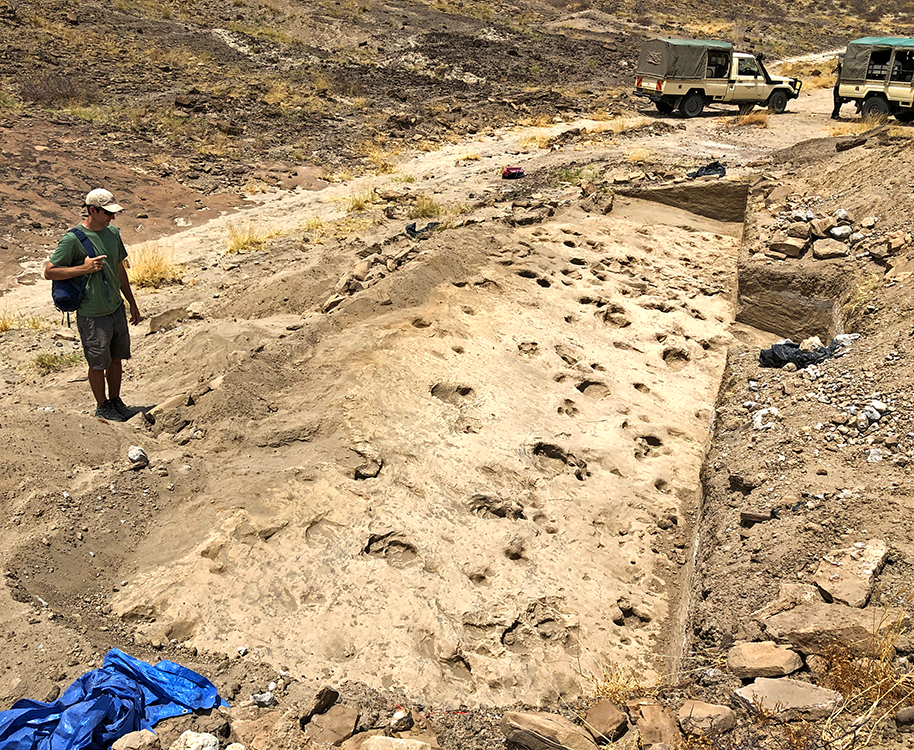
This is the situation faced by Dr Kevin Hatala of Chatham University and colleagues when they unearthed an extensive set of footprints on what was then the shoreline of Lake Turkana. Today the area is harsh, but for much of human history it was a sort of Eden, so rich in food and water that Homo erectus and Paranthropus boisei could live side-by-side for a long period of time.
My what big feet you have...
When Hatala and colleagues recreated the prints, they found a puzzle: these tracks appeared too big to be from Paranthropus, but the wrong shape for H. erectus. Unless a third species inhabited the area at the time, from which we have found no bones, our perception of one of these hominins must be wrong.
Modern humans have big toes that are more parallel to other toes than our tree-dwelling ancestors, and this can be seen in our footprints. This is thought to have evolved far enough back that Homo erectus would leave prints like ours. The Lake Turkana prints studied appear to come from feet with wide angles between the toes, which would suggest they were made by Paranthropus.
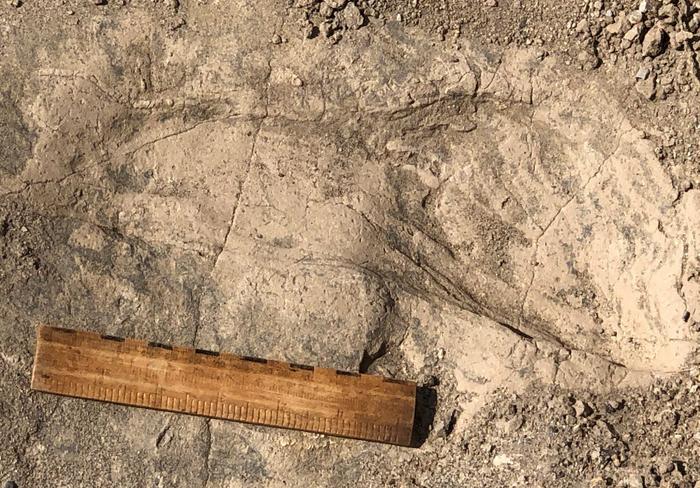
However, the prints are large, indicating "human-like body sizes – up to 1.8 meters [6 feet] tall and around 75 kilograms [165 pounds],” Hatala said in a statement.
The print sizes suggest six of the eight individuals who made them were more than 1.63 meters (5 feet 4 inches) tall. That’s above the average height of H. erectus, but still within its normal range. It's beyond the size Paranthropus has been thought to reach, however.
A single towering Paranthropus wouldn’t be too much of a shock to anthropology, but enough of them to form a basketball team is a different matter. Nevertheless, the authors consider that the more likely explanation.
Can't we all just get along
Giant P. bosei – plural – is surprising, not only because it is inconsistent with the Paranthropus bones that have been found, but because it contradicts the idea that the two species’ co-existence depended on different diets.
There’s little doubt that the foods H. erectus and Paranthropus ate overlapped. But if certain foods were exclusive to one or the other, then it’s easier to see how they lived side-by-side for an extended period. A larger Paranthropus doesn’t fit well with their hypothesized hard-to-chew but overwhelmingly vegetarian diet. It seems we need a more complex account of how the niche was shared.
The other significant aspect of the find is that Hatala and co-authors think at least six, and probably seven, of the trackmakers were male.
The Paranthropus bones we have found indicate substantial sexual dimorphism, with males larger than females. Surprising as it would be to find a group of males this size, 1.7-meter-high Paranthropus females would completely overturn what we think we know. Even for H. erectus, females of this size are barely credible.
Many primates live in groups with only a single adult male – other males are cast out when they reach maturity, until they’re ready to challenge for mates. Such behavior is usually linked to a substantial size ratio between males and females, so it was thought likely Paranthropus was similar.
“The fact that eight, mostly adult male, Paranthropus boisei individuals seemingly traveled together as a group, without females or children, hints at a complex social structure in this species,” said co-author Dr Neil Roach of Harvard University.
“They may have lived in large groups, where males competed for mates, but also tolerated each other at times for safety in a dangerous environment.”
Paranthropus, we hardly knew you
One reason we may have got our picture of Paranthropus wrong is that we don’t have a lot of their fossils, and most of what we have are jaws and teeth. With so few bones from below the neck, it’s possible we just happened to get relatively small specimens.
“I wouldn't say there has been a lot of confidence in Paranthropus boisei body size, but most of the existing estimates are relatively smaller than those for the contemporary species Homo erectus,” Hatala told IFLScience.
However, he acknowledged that perception may have been self-reinforcing. Bones that could come from either are often found without any clues of which species they came from.
“There has been a tendency to think that the smaller postcranial bones from this time period are attributed to P. boisei, while the larger postcranial bones from this time period belong to H. erectus,” Hatala said.
Hatala told IFLScience that with so few Paranthropus fossils, we don’t have much feel for how wide their range of sizes was.
“We don't really have enough fossil data to know how P. boisei body size varied across space and time.” Alternatively, it might not have only been Paranthropus’ jaws that were remarkably large relative to the rest of their bodies.
“We would really need to recover more of their fossils in order to know if they had unusually large feet relative to their overall body size,” Hatala told IFLScience. “A complete skeleton sure would be nice, but that's a lot to wish for!"
The study is published in Proceedings of the National Academy of Sciences.