


 Humans
 PUBLISHED


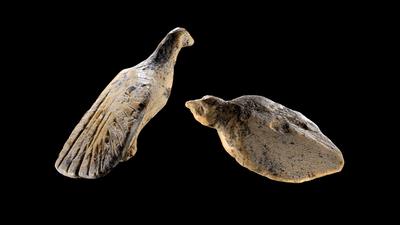


Over the past 150 years, the Hohle Fels cave in the Swabian Jura of Germany has produced some extraordinary artifacts from our ancient past. Now, it has offered up two more: a pair of extremely rare, exquisite bird figurines carved from mammoth ivory.
The finds, dating to 40,000 years ago, are thought to show birds in two different poses. One shows a bird crouching down in a flattened posture, which the researchers think might be brooding behavior as if the bird is sitting on a clutch of eggs.
The other shows a bird with its wings outstretched, either displaying or in flight. Unfortunately, only one of the wings remains intact, although the team has what they think are the fragments of the broken wing and hope that in time they might be able to repair it.
“Here, the mammoth tusk wasn't simply used to create some simplified form of a bird's body,” said Professor Nicholas Conard, research director from the Department of Prehistory and Early History at the University of Tübingen, in a statement.
“Here, precise observations of nature were translated into figures whose wealth of detail even allows for an examination of which bird species is depicted and what it is doing.”
.jpg "A side on picture of the bird in flight figurine.")
Conrad and his colleagues have tentatively identified the birds as ptarmigans. These are typically alpine birds in the grouse family, which can be found living across much of the Alps.
The two new finds are tiny. But even though they measure just a couple of centimeters (about 1 inch) long, they still show exquisite detail.
The bird thought to be brooding eggs has a delicate beak and eyes, with the natural lines of the ivory running down its back, while the bird in flight has beautiful feather detailing and even two little feet.
Curiously, these two new figurines add to a third thought to depict a duck already unearthed in the same cave a quarter of a century earlier.
Where are all the birds?
This simply adds to an intriguing mystery when it comes to European Ice Age art. While the artists were well-honed in producing astonishingly accurate and life-like paintings and statues of bison, mammoths, and horses, there are surprisingly few depictions of birds.
Considering the ubiquity of birds, and our enduring fascination with them throughout time and across cultures, it is weird that they appear so infrequently in Ice Age art.
“However, the figurines demonstrate that the carvers of the world's oldest art were able to depict birds in diverse and extremely intricate ways, and that certain motifs appear to be specific to particular archaeological sites,” says Conrad.
The eternal question is why our ancient ancestors were making these little pieces of art, a question that will never really have an answer.

Perhaps, the researchers suggest, they were made as a talisman for individuals, or maybe they fostered group identity and cohesion. What is abundantly clear, however, is that a lot of skill and dedication went into crafting these minutely beautiful objects.
“The modern humans must have had some kind of cultural and biological advantage that allowed them to out-compete the Neanderthals,” Conrad explains to Nature. “And this really kicks in around the time of all these sophisticated symbolic developments.”
“And I would argue that the origins of figurative art is strong evidence for different kinds of sophisticated artifacts indicating identity, therianthropic images, giving us proof of a system of beliefs that help people organize their lives.”
The little birds will be on display at the Blaubeuren Museum of Prehistory and Ice Age Art, Germany, in the exhibition "Featherlight and Research-Heavy – Discover the Miniature Birds of Ice Age Art" until April 4, 2027.



 1
1