Humans
 PUBLISHED
 1
1




What you'll discover in this article
- A scientist analyzed over 500 examples of cave art from the Basque Country and concluded they show a shared "syntax" that appears over and over.
- Far from being random, study author Iñaki Intxaurbe told IFLScience, rock art was "highly organized".
- He speculates that the art had other purposes beyond simply communicating information.
Prehistoric cave paintings may have been composed in accordance with a set of underlying structural principles, enabling artists to encode meanings through the symbolic arrangement of animals in their drawings.
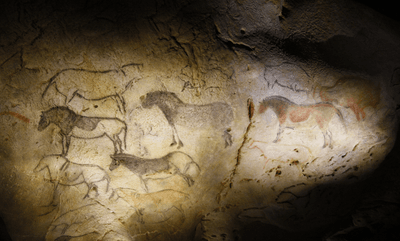
Analyzing more than 500 artworks from nine caves in the Basque Country, an archaeological researcher has discovered a remarkably consistent pattern in their layout, hinting at a shared “syntax” used by painters over thousands of years.
It’s impossible to try and explain it using one universal answer.
Iñaki Intxaurbe
“Rock art was not random or made by chance, but was highly organized,” says study author Iñaki Intxaurbe from the University of the Basque Country.
“There was a hierarchical structure dominated by symbology related with three animals - the horse, the bison, and the ibex,” he told IFLScience.
Located in the Bay of Biscay axis, the nine painted sites all date to the Magdalenian period, which spanned from roughly 18,000 to 14,000 years ago. In every cave, horses, bison, and ibex provide the structural backbone to the compositions, with other animals organized around these three dominant species.
“The orientation of these animals was also a factor,” says Intxaurbe. “For example, bison are more likely to be oriented to the left, while horses are facing right.”
In his new paper, Intxaurbe writes that these recurring patterns “support the existence of an underlying organisational grammar governing the combination and distribution of themes in Magdalenian cave art.”
He also points out that many of the caves were repeatedly visited and re-decorated over a period of around 4,000 years, and that the same compositional structure was adopted by multiple generations of artists.
“These are very complex sites that were reused for a long time, so it’s interesting to see that they always respected this structure,” says Intxaurbe.
And while he concedes that we may never decode the actual meanings of these motifs, he says “we are sure that this is a kind of communication system, so they are trying to share some information.”
In his statistical analysis of the distribution of visual elements, Intxaurbe found that the artworks adhere to certain linguistic patterns, reinforcing the communicative interpretation.
At the same time, he points out that the paintings likely had numerous functions beyond the transmission of information. For instance, he says that “the images represent a ritual symbology, so one function is to create a ritual area.”
“With rock art, we are facing a very, very complex system,” he adds. “So it’s impossible to try and explain it using one universal answer.”
The study is published in the Journal of Archaeological Method and Theory.