Nature
 PUBLISHED
 6
6


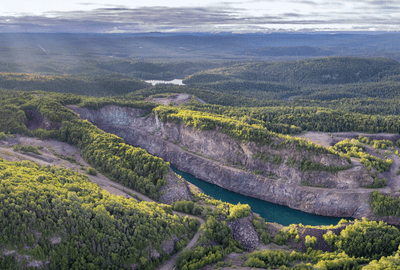


In 2013, deep within a Canadian mine, geologists discovered a fracture that contained the oldest known water on Earth. Hidden nearly 3 kilometers (1.8 miles) below the surface, the ancient water had been sealed away for around 2.64 billion years.
The unbelievably ancient water was discovered within a mine in Timmins, Ontario, an area that’s geologically known as the Canadian Precambrian Shield, the oldest part of North America’s crust. The site was an ideal place to search for ancient geological history because its layers of volcanic and sedimentary rock have remained relatively undisturbed by erosion and seismic activity, neatly preserving a record that stretches back billions of years.
The analysis of the water, published in the journal Nature back in 2013, revealed a chemical composition suggesting it formed under ancient atmospheric conditions. To find out when, the researchers turned to Xenon and other noble gases. Because noble gases are chemically inert and don't react with most other elements, they serve as a solid record-keeper. By analyzing the ratios of specific isotopes, scientists compared the water’s gas "fingerprint" to the known evolution of Earth’s atmosphere.
“Using isotopes of water and, in particular, noble gases, we can quantitatively determine whether waters have any modern component. And none of these do, so they are indeed isolated from the modern water cycle,” geologist and one of the authors of that study, Barbara Sherwood Lollar, professor in the Department of Earth Sciences at the University of Toronto, told IFLScience.
The initial work proved that the water was at least 1.5 billion years old. However, they suggest it could be much older, as it contained gases that appeared to have come from surrounding rocks and sediments over 2.6 billion years ago, right when the minerals were first forming.
That's really, really old. To put it into perspective, this water has been trapped underground in isolation long before plants, animals, or even complex cells existed. At around 2.6 billion years ago, Earth’s atmosphere contained little to no oxygen, and life was limited to simple single-celled organisms. Even the continents looked entirely different.
Speaking to IFLScience, Sherwood Lollar confirmed the water found in the Canadian Precambrian Shield is “still the oldest” ever discovered, at least to her knowledge.
Incredibly, the ancient water even contained chemicals known to support life. This is remarkable because it means that microbial ecosystems can thrive in the absence of light, totally cut off from the outside atmosphere, perhaps for millions of years. If life on Earth can live in these extreme environments, it raises the possibility that similar habitats elsewhere in the Solar System, such as those beneath the surface of Mars, could also support life.
But let’s get one thing straight: if you’ve ever heard the tall tale of the geologist who drank the world’s most ancient water, that story is a bit of a modern myth. While Sherwood Lollar said she could tell the water was bitter and salty from light splashes on the face, she certainly didn’t neck a shot of this stuff – and wouldn’t advise anyone else to do so.
“Alas, 'and she drank the water’ is a media invention. I did not and wouldn’t,” she told IFLScience. “But if you have seen the videos, you have seen there are flowing, bubbling waters, very actively in some places. Some drops inevitably land on you, and from that one can tell how bitter they are."
"I believe this so-called ‘quote’ or story came about because I was asked, ‘Can people drink the water?’ and I said, ‘No, it would taste terrible',” she added.
“It can be many times more saline than seawater – definitely not drinkable.”