Space and Physics
 PUBLISHED


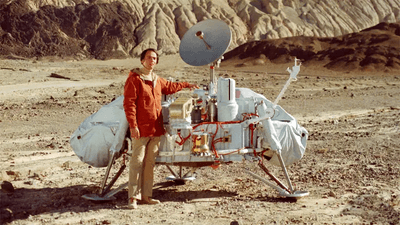


As the search for life on Mars continues – with promising potential biosignatures identified last year by NASA at the Bright Angel formation – there are a few scientists out there who think we may have found life on the Red Planet already, half a century ago.
According to the four authors of a recent paper, NASA's Viking lander may have detected signs of life on the planet in 1976, and we have incorrectly interpreted the probe's results. If that is correct, it means humanity has already had its first encounter with alien life, and it involved the alien life being obliterated by one of our robots.
In the new paper, the team suggests what that life might look like, based on those Viking experiment results.
In July and September, 1976, NASA's Viking Project touched down on the surface of Mars. There, it captured the first-ever images from the Martian surface and conducted biological tests on the Martian soil, specifically looking for signs of life – or ancient life – on the Red Planet. The results were fairly unexpected, and confusing, to scientists looking over them. Though most of the experiments were not promising, in one part of the experiment the lander found traces of chlorinated organics. But this wasn't clear-cut either.
"Even though the very first test at Viking 1’s Chryse landing site had been positive for organic synthesis (with a 99.7 percent certainty compared to the control sample), follow-on tests provided no clear results," Professor Dirk Schulze-Makuch of the Center for Astronomy and Astrophysics at Technische Universität Berlin, co-author of the new study, explained in a piece for Big Think. "The gas exchange experiment was just as puzzling: It showed the release of several gases, including oxygen, but scientists today still don’t agree on an explanation."
At the time, these organics were believed to be contaminants brought from Earth. Ambiguities in the data were swept aside as soon as the team announced that there were no signs of organic compounds on the planet. "That’s the ballgame. No organics, no life," Viking director Gerald Soffen famously said of the results, and scientists largely accepted that no signs of life were found by the mission. But for some time, several scientists have argued that the results were misinterpreted, and that there was evidence of organic compounds in the experiments and beyond.
In one part of the experiment, water containing nutrients and radioactive carbon was added to Martian soil. If life were present, the idea was that the microorganisms would consume the nutrients and emit the radioactive carbon as a gas, which could then be detected by the experiment.
"A substantial amount of radioactively labeled 14CO2 was released from 14C-labeled nutrients in an experiment designed to seek a Martian analog of respiratory metabolism. A substantial release of dioxygen (O2) and exchange of CO2 was observed when the Martian soil was humidified, in an experiment premised on the view that soil containing active microbes would exchange gases with the atmosphere, agnostic of its metabolic survival strategy," reads a recent letter published in Science, written by the team behind the new study in response to the original 1976 paper.
"Thus, by a 'preponderance of evidence' standard, Viking had found microbial life on Mars."
While the first experiment did find this radioactive gas, later results were mixed. If microbes were present in the soil, giving them more of the radioactive nutrients and incubating them for longer should produce more radioactive gas. But a second and third injection of the mix did not lead to the production of more gas. The initial positive result was put down to perchlorate, a compound used in fireworks and rocket fuel, which could have metabolized the nutrients.
But Schulze-Makuch and colleagues point out that perchlorate has since been found on Mars by the Phoenix lander and determined to be indigenous to Mars.
"In 2010, Rafael Navarro-González and his colleagues showed experimentally that methyl chloride is generated when organic materials are destroyed when they are strongly heated with perchlorate," the team writes in their new paper. "Perchlorate had been discovered in the Martian soil by the Phoenix lander 1 year earlier. Thus, the organic chlorides observed by the [gas chromatography-mass spectrometry] experiments are now thought to be evidence for organic molecules in the Planitiae soils, not evidence against their presence. And many organic species have now been detected by rovers elsewhere in Martian soils."
If the Viking lander did find life on the planet, there's a good chance it killed it during that experiment. In another piece for Big Think, Schulze-Makuch cited life found in extreme environments here on planet Earth, such as microbes found in the Atacama Desert. An excess of water poured on these microbes would certainly kill them, perhaps explaining why the Viking experiment did not see a second release of radioactive gas – you don't tend to be that hungry when you're dead.
So, what if it is life? What would that look like, and could it explain the results seen by the Viking mission? In the new paper, the team suggests (as a starting point for discussions) that bacterial autotrophs respiring with stored oxygen could survive in a semi-dormant state near the surface "ready" to become non-dormant when water and adequate warmth becomes available.
"Even with H2O available only as water vapor, a Martian microbe could fix carbon via the reaction CO2 + H2O + energy → “CH2O” + O2. The discussion would begin by suggesting that Horowitz observed exactly this process in his experiments that sought evidence of Martian photosynthesis," the team explains, adding that dormancy might be the preferred survival strategy on the planet, given the very cold nights on the planet.
In this scenario, the Martian bacterial autotroph would store oxygen for overnight metabolism, and be ready for fixing carbon when it becomes available. According to the team, this could, perhaps, account for results seen in the Viking experiments.
"In addition to releasing O2, the Martian soil was observed to exchange a substantial amount of CO2,"they write. "Again, to be ready to come out of dormancy, an adapted Martian organism would pre-absorb CO2, prepared to instantly start creating organic molecules in the event that it encountered scare water and energy resources."
The team calls this potential life Bacterial Autotroph Respiring with Stored Oxygen On Mars, or BARSOOM, the name Martians give to the planet Mars in the sci-fi novel A Princess of Mars by Edgar Rice Burroughs. Nevertheless, the team does not claim to have proven that this is the explanation for the Viking results.
"The purpose of this note is to start the back-and-forth dialectic that should have started a half century ago as a result of the Viking 1976 experiments," the team writes, adding that the question is becoming more urgent with the possibility of crewed missions to the planet, and the possibility of returning Martian life accidentally to Earth. "Thus, future Mars exploration must have this back-and-forth, and this should begin today."
Perhaps this new paper will spark further discussion on the topic, as we continue to look for life on the Red Planet.
The study is published in the journal Astrobiology.