Nature
 PUBLISHED


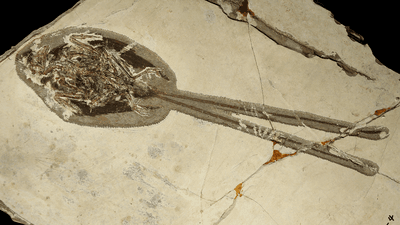


How do you impress a partner? A big romantic gesture like in the movies? A bouquet of red roses? In the bird world, the answer is usually to flash your tail feathers, and it seems, thanks to a newly analyzed fossil, that sometimes the old ways are the best – and by old, we mean really old.
To be more specific, we're talking about a 121-million-year-old fossil of new bird species, named Plumadraco bankoorum. It is thought that it belonged to the enantiornithines, a now extinct but very large group of birds that lived in the Cretaceous period and that died out alongside dinosaurs during the asteroid strike 66 million years ago.
Measuring only 15 centimeters (5.9 inches) long in its from beak to rump, the ancient bird is followed by a pair of ornamental tail feathers that are nearly double the length of its body.
“Plumadraco was the size of an American robin, but its tail feathers were about a foot long, twice the length of its body,” said lead author Alex Clark, a PhD candidate at the Field Museum and the University of Chicago, in statement. “They’re some of the proportionally longest tail feathers ever found in a fossil bird.”
With this specimen, we have a pretty strong argument that not only did probable males try to attract females with feather ornamentation, but they also did so with ridiculous lengths, and probably displays.
Alex Clark
The name Plumadraco bankoorum – or Banko’s feather dragon – in part honors its impressive tail feathers, but also Winston and Paul Banko, a father-son team of avian biologists who have made significant contributions to the conservation and understanding of bird species in the Hawaiian archipelago.
The fossil was being stored at China’s Shandong Tianyu Museum and it was only a passing glance during a research trip that alerted Clark to it.
“I saw this little guy, and I did a double-take when I saw the tail feathers,” said Clark. “I’m really interested in the way birds do displays to attract mates, and I thought that these tail feathers were so crazy, they had to be used for something like that.”
Clark and the team took detailed photographs and measurements of the extraordinarily well preserved specimen; even having the long tail feathers is a rare feature for a fossil of this kind. The team also used a mass spectrometer to analyze the fossil in more detail, allowing them to find out what color the feathers would have been based on the amount of different chemicals present.
It's likely based on the results that the feathers were dark brown or black, and the ends of those all-important tail feathers had some iridescence or blue shine. However, that is caused by the structures of the proteins inside the cells and not pigments, hence the reason why there are no blue mammals (for now).
.png "A drawing of what the male and female birds might have looked like on a mossy log. The male has a green head and brown wings with long black tail feathers, but the female is pale chested with brown wings and no green.")
The feather structures are also so well preserved that the team were able to tell that the tail feathers were not used for flight but instead were likely flicked behind the body. Though sex is hard to distinguish due to the lack of soft tissue preservation, it is like the specimen is a male, its ornate tail features a way of impressing the females, similar to modern bird species.
“The most interesting findings [of this research] are 1) that the length of this species’ tail feathers is a new record for any enantiornithine (the most diverse group of birds during the Mesozoic), and 2) the structure of the distal rackets themselves,” Clark told IFLScience.
“The feather’s structure changes throughout its length, and these differences would result in varying levels of swaying or flickering should the feathers be moved. The tail feather’s rackets are distally enfeebled, meaning that less than halfway into each racket, the rachis (central support structure) completely ceases. You can see similar patterns in birds today,” he added.
“With this specimen, we have a pretty strong argument that not only did probable males try to attract females with feather ornamentation, but they also did so with ridiculous lengths, and probably displays – which can be inferred from both feather structure and muscle tissue traces from other enantiornithine genera,” Clark told IFLScience.
.jpeg "A hand holds a mass spectrometer over the fossil which is laid flat. The spectrometer is connected to a laptop that can be seen in the background.")
Modern day birds such as peacocks, have rump coverts (not the fancy tail feathers) that shake or flicker, in a similar manner to how the tail feathers of Plumadraco would have moved due to the structures that make up the tail.
“It means that 121 million years ago, this male Plumadraco was dragging along a train of tail feathers twice its body length, just to impress potential mates – something we see today in modern birds as well. Pretty cool if you ask me,” said Clark.
As for what he hopes we all take away from this research, Clark had a very wholesome response for us: “I would hope that this specimen, like everything that I do in my research, would temporarily shift focus away from us, and place it onto the natural world. There are far more rich and interesting things out there to study and protect than just what we deem valuable or worthwhile as humans.”
“As with all my paleontological research, it’s a great honor to be able to introduce a new organism, a new individual, to the rest of my species,” Clark added. "This individual hasn’t seen the sun in over 121 million years – and now here you are reading about it. That makes me incredibly happy. It’s like mediating a handshake between the general public and a dinosaur.”
The study is published in PLOS One.



 1
1