Nature
 PUBLISHED
 1
1


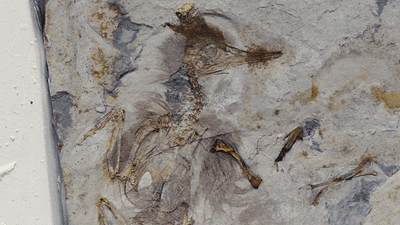


Anatomists will tell you that every corpse tells a story, and the same is true of fossils. Long dead, animals can reveal strange clues as the passage of time compresses them into an imprint of a life. It means that sometimes you find stuff that just doesn’t make sense. Case in point, a new species of 120-million-year-old bird found with a throat full of stones.
The sparrow-sized bird (now known as Chromeornis funkyi) had big teeth at the end of its beak like a larger fossil bird called Longipteryx but otherwise was very different. To Dr Jingmai O’Connor, associate curator of fossil reptiles at Chicago’s Field Museum, it was obvious that it was a new species, but she never could’ve guessed what she’d find when she took a closer look.
Inside its neck was a mass of tiny stones. The way they had fossilized suggested they hadn’t washed in after death but were actually the cause of death, lodging in the poor animal’s throat and choking it to death. The big mystery, however, is how on Earth those stones got there.
“My first thought was that they were gizzard stones but that it was super unusual that the mass was in the esophagus,” O’Connor told IFLScience. “I just assumed that the mass was pushed up through the digestive system but the deeper I dug, the clearer it became that this mass of stones was unusual in every way (not just position but in size, proportions, volume etc).”

Gizzard stones, also known as gastroliths, are a tool for digestion that animals alive today still use. Essentially you become a living pestle and mortar by swallowing a few rocks that can help to grind up the things you swallow. It’s practiced by reptiles like crocodiles, and birds, just like our fossil.
Thing is, of the thousands of fossils we’ve found of birds in the same group as this fossil bird, we’ve never found evidence of gizzards. O’Connor and colleagues decided to dig into the archives looking at all the fossils that have been found with gizzards stones to see if perhaps this little bird was just the first of its kind to be discovered with gastroliths.
They worked out the average size and number of gizzard stones based on the size of the birds so they could compare it against this new and confusing fossil. It revealed that whatever had gone on, it wasn’t gizzard stones.
For starters, the tiny bird had over 800 tiny stones in its throat, way above what you’d expect. Furthermore, based on their density it seems that some of them weren’t even stones but tiny balls of clay.

So, a very weird fossil find. In fact, of all the fossils O’Connor is aware of (which, by the way, is a lot), she’s never heard of someone finding stones inside the throat of an animal. So, what happened to this bird?
One explanation is illness. We know that birds alive today can start to behave very strangely when they’re unwell, and swallowing a load of material wouldn’t be beyond the realms of something a bird might do in a bad state. When the mass of stones didn’t agree with its stomach, the bird may have tried to regurgitate it only for it to get stuck. Pressed against its neck and airway, it was a fatal final meal.
Finding an obvious cause of death in a fossil is rare, but not unheard of. In fact, O’Connor has some great examples of fossils that have had a hell of a story to tell.

“I published on another fossil enantiornithine bird with an egg preserved inside of it (Avimaia),” she told IFLScience. “The egg was also unusual (the eggshell was too thin) so we concluded that the bird died of egg binding, a condition when for some reason the egg cannot pass out of the body, causing death.”
“I also published on a fossil bird called Yanornis that had impacted intestines. It had gastroliths in its abdomen which were thought to be gizzard stones, but I showed they were actually tiny stones filling the intestines. This can happen when some intestinal blockage occurs, again, resulting in death.”
“Other incredibly well preserved fossils, like the famous fighting dinosaurs from Mongolia or the sleeping dragon Mei long, tell us these animals died suddenly due to immediate burial (in the case of the fighting dinosaurs, a dune collapsing, in the case of Mei long, a volcanic eruption).”
And those fighting dinosaurs? They had a lot to say about Tyrannosaurus rex, too.
The study is published in the journal Palaeontologica Electronica.