Nature
 PUBLISHED






What you’ll discover in this article
- Shell-forming plankton underwent the second-worst mass extinction on record 113 million years ago.
- The cause of this extinction has been traced for the first time to ocean acidification caused by an increase in atmospheric carbon dioxide.
- Dr Jonathan Chen explains to IFLScience why, unlike in some other marine mass extinctions, deep-sea life was relatively unaffected.
A mass die-off 113 million years ago has been attributed to a change in ocean chemistry that was too rapid for most species to cope with. The chemical change in turn was caused by a vast volcanic province that added trillions of tons of carbon dioxide to the atmosphere and oceans.
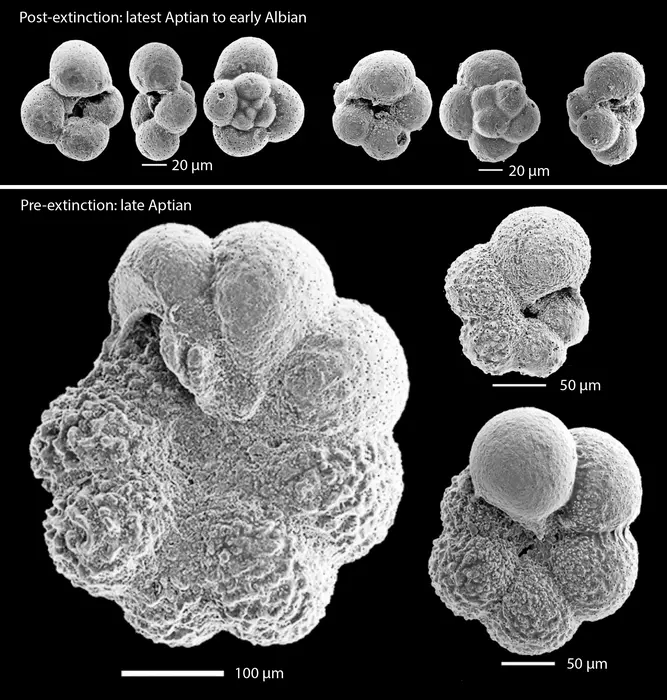
Foraminifera are minute shelled organisms that exist in vast abundance in the oceans. Their calcite shells ensure better fossil preservation than other ocean plankton, and their deposition on the seafloor allows scientists to study ancient climates.
Now, deposits from 113 million years ago indicate these ocean plankton underwent widespread extinction without immediate replacement.
“By examining fossils, scientists already knew surface plankton were getting smaller and building thinner shells, which suggested they were under stress,” said Dr Jonathan Chen, previously of Northwestern University, in a statement.
The geological record emphasizes that current CO2 emissions are unprecedented in Earth’s history and thus pose a major threat to modern biota and environments.
Jonathan Chen
This extinction event marks the boundary between the Aptian and Albian ages during the beginning of the Cretaceous. It's thought to have been the second largest foraminifera extinction event in history, only surpassed by one at the end of the Cretaceous.
The end-Cretaceous event was bad for everyone, not just marine plankton, but there’s a reason you haven’t heard about an upsurge in dinosaur deaths during the early Cretaceous – as far as we know, there wasn’t one.
“We do not observe a global mass extinction that wiped out a broad spectrum of terrestrial or marine fauna or flora,” Chen told IFLScience.
That left paleontologists wondering why marine life was so hard hit.
The surface vs. the deep sea
The cause had to lie in something that mainly affected the oceans, making ocean acidification the obvious suspect.
But to complicate things further, the fossil record seems to show that only animals living in the ocean's upper layers of water were impacted. Foraminifera living on the sea floor appear unaffected at this time.
To help explore what was going on, Chen turned to the calcium isotopes preserved in the fossil shells. The isotopes change depending on how quickly foraminifera form shells, which in turn reflects the conditions they were growing in.
“By measuring the fossils’ calcium isotopes, we finally provided that missing evidence,” says Chen. “We found a giant increase in calcium isotope ratios right as the extinction unfolded, indicating the organisms’ shells were calcifying at a much slower rate.”
“That was the smoking gun linking ocean acidification to the severe biocalcification stress that ultimately led to their extinction.”
Ocean acidity is closely tied to the amount of carbon dioxide in the atmosphere. As the amount of atmospheric CO2 increases, more of it dissolves in water to form a weak acid that balances the ocean’s natural alkalinity.
During the early Cretaceous a vast volcanic province on the Kerguelen Plateau erupted, spewing enormous amounts of carbon dioxide into the air.
The team then compared the foraminifera species that lived near the surface with those that lived at depth. While less impacted, the team still found the same pattern in the deep ocean, albeit much more weakly.
“Because the CO2 entered the atmosphere first, it hit the surface waters and created ocean acidification before it could reach the deeper ocean,” Chen added. “That wiped out the planktic foraminifera, so they couldn’t make their calcite shells anymore.”
This partly explains why it was only the surface-living species that were affected. But that isn't all.
While foraminifera depend on an alkaline ocean, the very act of forming their shells is actually slightly acidifying.
Once shells stopped forming near the surface, “the excess alkalinity circulated through the water column, making it available for benthic foraminifera living on the seafloor,” explains Chen. “That saved the benthics from being affected too badly.”
“This biological compensation would have also enhanced atmospheric CO2 drawdown via increases in surface-water alkalinity.” This, in turn, would have reduced any effects on terrestrial life.
An unusual extinction
The pattern of extinction is different from ones we have seen during other periods of volcanic eruption. The authors think this could be because many volcanoes are on the sea floor, and so when they erupt the carbon dioxide is dispersed directly into the water.
In other cases, Chen explains, the timing could have meant that “organisms and, by extension, biogeochemical cycles, have some ability to compensate.”
While we're not emitting as much carbon dioxide as the Kerguelen Plateau eruptions did, we’re releasing it thousands of times faster. This means the planet has less time to absorb it, or life forms to adapt.
With our emissions going directly into the atmosphere, as opposed to the deep sea, it means the early Cretaceous event is a better model for how plankton are likely to respond.
“We know ocean acidification is already happening as a consequence of human-made CO2 increases,” Professor Brad Sageman said. “It’s measurable in our oceans. Studying these past events gives us a sense of the range of variance.”
“We note, however, that our findings should not be extrapolated to lessen concerns about current human-caused climate change,” says Chen.
“Anthropogenic CO2 emissions are occurring at rates far beyond those seen during the Aptian/Albian boundary and other eruptions in the geologic past… the geological record emphasizes that current CO2 emissions are unprecedented in Earth’s history and thus pose a major threat to modern biota and environments.”
The study is published in Science