Nature
 PUBLISHED


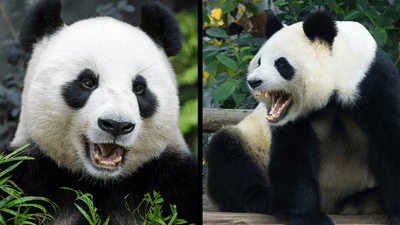


Of all of the eight bear species on the planet, the one striking considerably less fear into our hearts has got to be the giant panda. Famous for being a symbol of diplomacy and conservation, this black and white creature is surely on the cuddlier side of the bear family, but just because they are adorable doesn’t mean that you should cuddle them – it might not end well.
First, giant pandas are big; they're between 60 and 90 centimeters (2 to 3 feet) tall at the shoulder when on all fours and can weigh around 113 kilograms (250 pounds). While this is nowhere near the weight of a polar or brown bear, it is still a force to be reckoned with.
Then there's their chomp. Pandas have an extremely strong bite force of nearly 1,300 newtons at their canines, which only puts them behind polar and brown bears when it comes to ursids with the strongest bite force – and we know those two can be dangerous.
Pandas have specially adapted flat teeth and jaws that allow them to chew through tough bamboo all day, so it's no wonder they could do some serious damage to human tissue if they so choose. There is no documented case of a panda killing a human, but while attacks are rare, they're not as unheard of as you might think.
For example, a study from 2014 reports on three cases of giant panda attacks on people at Beijing Zoo between September 2006 and June 2009. Fair warning, there are some pretty grisly (or should we say grizzly) images and descriptions in the study, so maybe give that link a miss if you're about to have your lunch.
The case covered by the study occurred after a drunken man jumped into the giant panda enclosure to try to stroke one of the pandas. In the end, a panda named Gu Gu landed a serious bite on his right calf, and the man was taken to hospital, where he received surgery.
Another man was also bitten by Gu Gu after either accidentally falling into the enclosure or entering it to retrieve his son's toy, with BBC News reporting that the panda had to have its jaws forced open to free the man. The man was bitten on the calf, and the wound had to be debrided three times until it was clean and stable.
The third case the authors documented involved a man who also accidentally fell into the enclosure and was attacked by a giant panda on his left foot and right elbow. A skin graft was performed to cover the wound on his foot.
All three people survived their injuries. “From these three cases, we can see why the giant panda was classified into the family Ursidae and it may attack humans when infuriated or frightened, even though it is usually very gentle,” explain the authors in their paper.
Panda attacks on people in the wild are also extremely rare, largely because pandas are pretty good at staying out of the way of humans. However, pandas are known to fight each other for access to females and territory.