Nature
 PUBLISHED
 1
1



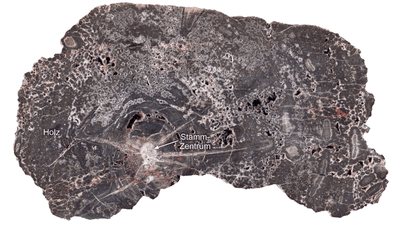


Fossil hunters usually get most excited when they find remnants of animal bones or teeth, but a paper describing how fossil wood can encode millions of years of geological history reminds us how plants, too, are indispensable in helping us understand our planet’s prehistory.
The study, which investigated fossil wood from the Kyffhäuser Mountains in northern Germany’s Saale Basin, notes that “Among all organic hard tissues, wood has the strongest chemical affinity to mineralize.”
And that was certainly the case for this particular wood, born from great trees in a forest that flourished before the dinosaurs in the Carboniferous Period. These trees were buried in riverbeds in a tropical part of the supercontinent Pangaea, in a region that swung between dry seasons and floods.
Once buried, the study reports, the wood underwent four rounds of mineralization over the subsequent millions of years, each creating a different form of quartz and revealing important information about the basin in which it grew.
“It is astonishing that a fossil, often no bigger than the palm of a hand, encapsulates the geological history of an entire region spanning hundreds of millions of years,” said Dr Steffen Trümper at the University of Münster in Germany, in a statement.
A forest of stone
Conditions 304 million to 299 million years ago allowed silicic acids to enter the buried wood and produce opal formations that preserved the shape of the cell walls, the study reports.
Then, between 299 and 290 million years ago, the fossils were buried beneath sediments and heated to temperatures between 50°C and 70°C (122°F and 158°F), which turned the opalized wood into crystals of fine quartz.
These processes have preserved a record of evolutionary lines that are now extinct and whose closest living relatives are conifers, Trümper and his team write, but further transformations to the fossils have received less attention.
The team found that, once enough layers of strata built up above the mineralized wood, heat, pressure, and salinity caused most of the fine-crystalline quartz to be replaced with coarser quartz-hematite crystals, erasing the preservation of the anatomical structures where this occurred.
Another long period of stasis followed, they write, before exposure to temperatures between 170°C and 290°C (338°F and 554°F) created yet another form of quartz: blocky euhedral crystals.
The final transformation involved the production of quartz baryte, which is recognizable by its production of blue light when it is bombarded with electrons, a process known as cathodoluminescence.
What is revealing about the transformations through these four forms of quartz is that each requires different temperatures and pressures, and that the wood retains an indication of when each stage occurred.
Nuclear clockwork
Quartz crystals capture uranium from the surrounding environment as they form and exclude lead. Uranium slowly decays to lead, so the ratio between the amount of lead and uranium should tell a geologists how much time has passed since the crystals formed.
Lead can sometimes enter or escape crystals through other processes, so careful checking is required, but Trümper told IFLScience that his research team accounted for this. He added “Actually, we were really surprised that the [uranium-lead] clock that started with initial mineralization in the late Carboniferous was not completely set back during later processes.”
It provides science with a new tool for tracing the evolution of continents.
Steffen Trümper
By studying the age of crystals surviving from each stage of formation, Trümper and his colleagues created a timeline of the transformations, with quartz-hematite forming 257 million to 260 million years ago, euhedral quartz 180 million to 150 million years ago and quartz baryte around 100 million years ago.
The transformations require specific temperatures and pressures, both of which are related to how far underground the wood lay at the time. Consequently, the team has a series of snapshots of how much material lay above the former wood at each point in its history. The final conversion required depths of between 3 kilometers and 5.5 kilometers (1.9 miles to 3.3 miles).
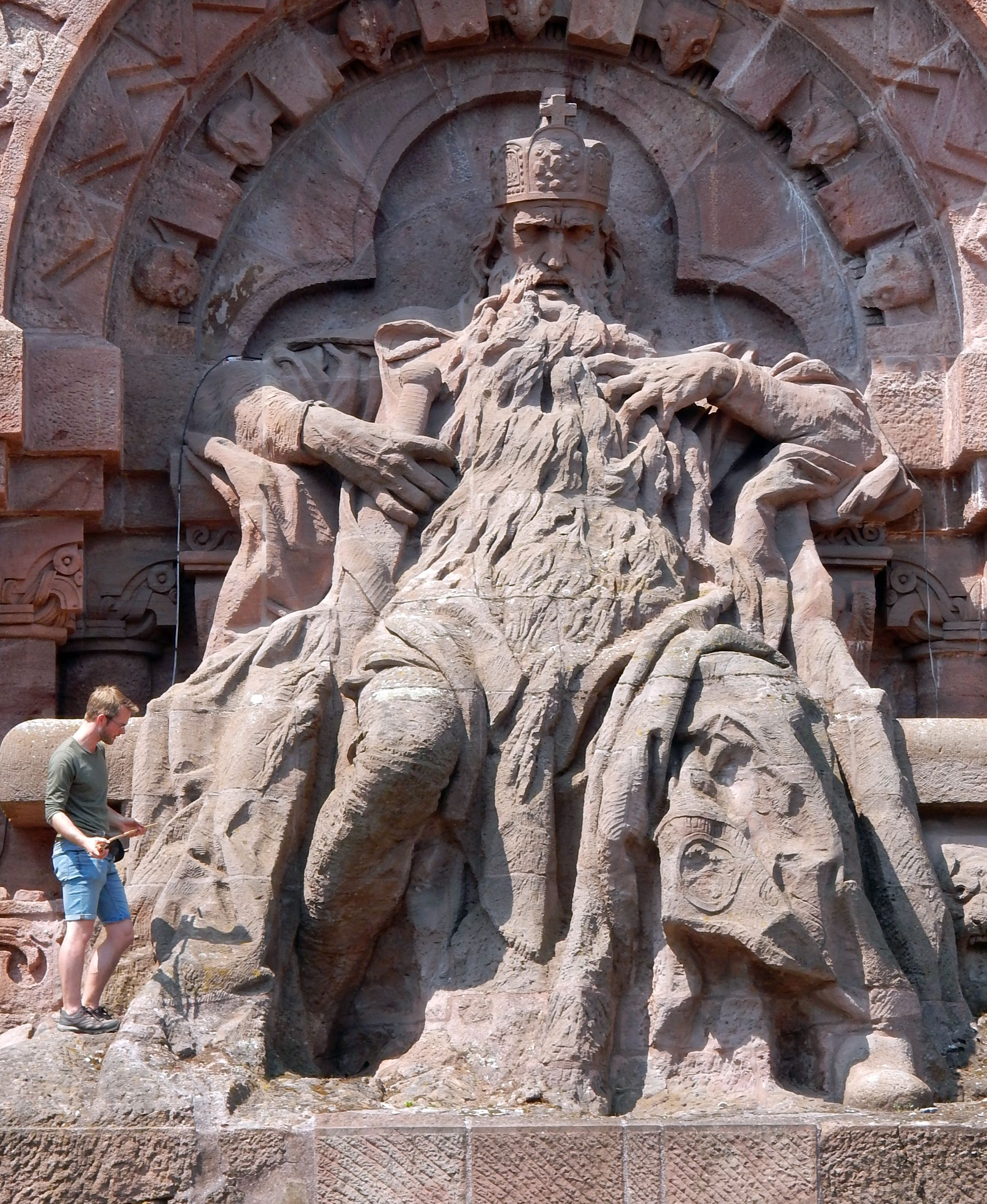
Today the fossilized wood lies at the surface, coincidentally in front of the Kyffhäuser Monument, one of Germany’s tallest statues, so the geologists know a there must have been an immense uplift in the more recent past. Collectively, these events tell the story of the region’s geology over 300 million years.
“The tiny fluid inclusions in the quartz were particularly revealing, as they preserve information about the exact conditions during crystal growth,” Trümper said in a statement.
"As fossilized wood occurs in many rock formations worldwide, this opens up a valuable source of information. It provides science with a new tool for tracing the evolution of continents.”
Nevertheless, just as most forests never become fossilized wood, most fossilizations won’t complete all the stages seen at Kyffhäuser. Just 80 kilometers to the south at Manebach, conifer stems also experienced mineralization.
“The delicate preservation of cell structures is much better than in the Kyffhäuser, and even intracellular fungi can be found,” the authors note. “However, attempts to analyze fluid inclusions and to date the Manebach fossils using the [uranium-lead] isotope system did not yield satisfactory results.”
Trümper told IFLScience that when lasers were directed at Manebach samples “Bigger pieces broke of the sample instead of small ones needed to analyze the isotopic composition,” and the team don’t know how widespread this problem would be for researchers analyzing wood from other places.
Nevertheless, Trümper said, a recent paper on fossilized wood in China describes a site that “seems promising” for documenting a similar sequence of transformations.
The study has been published open access in Scientific Reports.