Space and Physics
 PUBLISHED


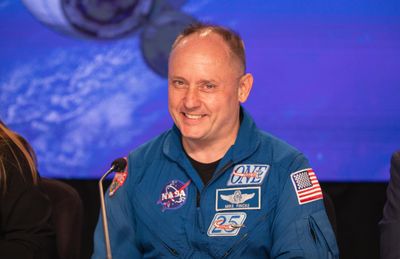


In January, just a few weeks short of the expected six months, Crew-11 came back from the International Space Station. The early return marked the first time a mission had been cut short for medical reasons. At the time, neither the astronauts nor NASA revealed the nature of the incident or who experienced it. Yesterday, the agency announced that it was Mike Fincke.
Fincke is a veteran astronaut, having spent 549 days in space across multiple missions; he has been certified as a mission specialist on the Space Shuttle, a co-pilot on the Russian Soyuz, as well as a pilot for the SpaceX Crew Dragon and the beleaguered Boeing Starliner. He has completed 48 hours and 37 minutes of extravehicular activity across nine spacewalks. And it was just before his 10th spacewalk that something happened.
“On Jan. 7, while aboard the International Space Station, I experienced a medical event that required immediate attention from my incredible crewmates. Thanks to their quick response and the guidance of our NASA flight surgeons, my status quickly stabilized,” Fincke said in a statement shared by NASA.
“After further evaluation, NASA determined the safest course was an early return for Crew-11 – not an emergency, but a carefully coordinated plan to be able to take advantage of advanced medical imaging not available on the space station.”
Astronauts are trained to deal with medical emergencies in space. They have shared videos on how they’d perform CPR in space, and there is telemedicine on board, including tests done with a holographic doctor. Fincke praised the crucial role of the ultrasound machine in this emergency during the return press conference.
“On Jan. 15, we splashed down off the coast of San Diego after an amazing five-and-a-half-month mission. I am deeply grateful to my fellow Expedition 74 members – Zena Cardman, Kimiya Yui, Oleg Platonov, Chris Williams, Sergey Kud-Sverchkov, and Sergei Mikayev – as well as the entire NASA team, SpaceX, and the medical professionals at Scripps Memorial Hospital La Jolla near San Diego. Their professionalism and dedication ensured a positive outcome," Fincke added.
The nature of the medical emergency has not been shared, and it will be up to Fincke to do so if he considers it necessary in the future. He reports that he’s well.
“I’m doing very well and continuing standard post-flight reconditions at NASA’s Johnson Space Center in Houston. Spaceflight is an incredible privilege, and sometimes it reminds us just how human we are. Thank you all for your support,” Fincke concluded.