Nature
 PUBLISHED


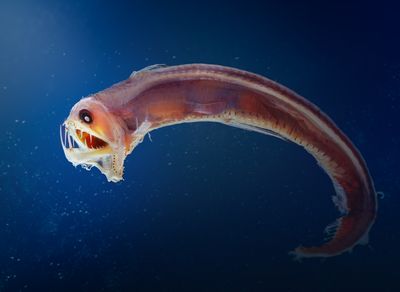


Fish having teeth is a bit disconcerting to say the least. I mean, have you seen a pacu? There’s one species, however, that takes its chompers to the absolute extreme. No, not the great white shark. We’re talking about Sloane’s viperfish (Chauliodus sloani), aka the deep-sea demon from your nightmares, and its massive gnashers.
According to Guinness World Records, Sloane’s viperfish is the fish with the biggest teeth relative to its head size, making up just over half of its head length. In fact, its fang-like, not-so-pearly whites are so long that they overlap the jaws when its mouth is closed.
But before you forgo your dream career of deep-sea exploration in fear of this fish gobbling up your sub à la The Meg, there’s something important you should know. Sloane’s viperfish don’t tend to be bigger than 35 centimeters (13.8 inches) in length, with their teeth even smaller at just over 1 centimeter (0.4 inches) long.
The Pacific viperfish (Chauliodus macouni) is in the same genus as Sloane's viperfish and has similarly scary (and useful) teeth.
While that’s reassuring to us, that doesn’t mean that a Sloane’s viperfish isn’t a force to be reckoned with, at least not for the other bony fish and small crustaceans that it preys upon.
Dinner and a (light) show
Forget the teeth for a moment and Sloane’s viperfish are a pretty unassuming iridescent dark silver-blue – that is, until the light show begins. The sides of these fish are covered in small light-emitting organs called photophores, which flash blue-green or yellow.
Not only do the flashing lights help to mask the viperfish’s silhouette from predators, but those on its elongated first dorsal ray may also help to lure in prey.
It’s at this point where things can get unhinged – literally. It doesn’t pay to be picky about your portion sizes in the deep sea and so to help it gobble up bigger prey and get its teeth out of the way, Sloane’s viperfish can unhinge its jaw, letting its mouth open up to 90 degrees.
Combined with the ability to expand its stomach, this allows the viperfish to snack on food up to 63 percent of its own body length. Considering that, it’s not all that surprising that fish in this genus are thought to only eat around every 12 days.
Once the prey is in place, the jaw snaps back down; this bite is powerful to the point that Sloane’s viperfish’s first vertebra, which sits behind its head, has evolved to act as a shock absorber.
Even if something is small enough not to have been impaled by the viperfish’s mighty bite, there’s not much chance of it being able to escape. With its mouth closed, the teeth once again overhang and can even rotate inward, creating a cage that traps the prey within.
Let’s all be very grateful that this thing has stuck to being small and living in the deep sea.


 1
1