Space and Physics
 PUBLISHED




Beyond the protective bubble of our atmosphere, space remains at the very least a challenging and often an extreme environment. Where humans are yet to tread, we can send robots. And those robots are getting better and better.
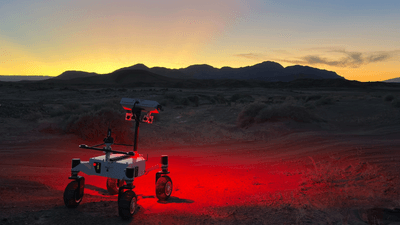
NASA’s JPL has recently sent a prototype rover across the Colorado desert. Over 37 hours of driving, across seven days of intermittent testing, ERNEST (Exploration Rover for Navigating Extreme Sloped Terrain) covered about 26 kilometers (16 miles).
ERNEST is an exciting prototype because it can easily traverse challenging landscapes as well as moving an order of magnitude faster than the top speed for Perseverance and Curiosity on Mars. It is designed to face terrains that might stop either of the Mars rovers.
“This testing is helping us refine the mobility hardware and autonomy software to navigate extreme distances across a wide range of terrain and lighting conditions anticipated on the Moon,” Issa Nesnas, a principal technologist at JPL who led the recent testing as head of autonomy for a NASA mission concept for a potential future long-range lunar rover, said in a statement.
Rovers that can go farther, faster, and with more autonomy are seen as a key element of NASA’s Moon Base ambitions. Nesnas's team is now working on a prototype twice as large as ERNEST, which is 1.2 meters (4 feet) long, and can go equally far and fast.
“You could do a science road trip across the Moon – or Mars – with this vehicle,” James Keane, a JPL planetary scientist working on lunar missions.
It's a marathon (and sometimes a sprint too!)
A rover certainly doesn’t just drive around aimlessly, but the comparison of what ERNEST covered in one week to what the Martian rovers have done so far is truly staggering.
Opportunity, between 2004 and the end of the mission in 2019, traveled a total distance of 45.16 km (28.06 miles). Curiosity, which landed on Mars in 2012, did 37.16 km (23.09 miles). Perseverance, in just five years, completed its first marathon just days ago, and it is now bound to overtake Opportunity’s record.
“It's up to the science team to choose how the rover spends its time. If the goal were to drive several kilometers away quickly, we could accomplish that in a matter of weeks,” Mark Maimone, a long-time rover driver and mobility engineer at NASA's Jet Propulsion Laboratory, told IFLScience.
“But most likely we will be performing science assessments using the many sensors on the rover rather than just driving, so it will likely be a while before we match Opportunity's record," Maimone explained.
"I do want to note that Opportunity drove for nearly 15 years, whereas we are not yet at five years of operations, so we're likely to surpass Opportunity's record 3x faster than it did!”
Perseverance has autonomous capabilities when it comes to its motion. While the drivers still decide where it goes, the rover by itself performs dozens of checks multiple times per second to make sure the it stays safe – a fundamental way to make sure that the rover can move quickly but in safety.
“It's a great engineering achievement to have our latest Mars rover able to drive itself quickly enough that self-driving is now the primary way we accomplish long drives. In fact, over 90 percent of all driving on Perseverance is now being done autonomously.”
The successors of ERNEST will be even more ready to make autonomous decisions on where it’s best to go and how to best cover that distance. Before we get to those, we will see the autonomous driving capability of a European rover: ESA’s Rosalind Franklin will drive across Mars and drill into its subsurface, from about 2030.
Back to Saturn!
The ability to make good decisions while in motion is not restricted to Mars, but it will come into play with one of the most exciting missions that NASA is planning: Dragonfly. This robotic explorer is expected to land on Saturn’s largest moon Titan in 2034.
It will follow the success of the Mars helicopter Ingenuity – at first a simple test vehicle before becoming a full companion to Perseverance, this was the first flying vehicle on another world.
Dragonfly will kick that up a notch, becoming a flying science lab capable of exploring diverse terrains of the only other world in the Solar System with rivers and lakes.
“Dragonfly isn’t a mission to detect life – it’s a mission to investigate the chemistry that came before biology here on Earth,” Zibi Turtle, Dragonfly Principal Investigator, Planetary Scientist at Johns Hopkins Applied Physics Laboratory, said in a statement.
Titan’s rivers and lakes are not made of water. The moon is too cold for that. They are made of methane and other hydrocarbons. Many scientists believe that Titan’s composition might be similar to what Earth's was before life took over.
Dragonfly might even help work out what the mysterious compound that has been recently discovered on the surface of Titan (and on Pluto as well) is. Being so far from home, with communications taking between 70 and 90 minutes, autonomous decisions will play a role.
Dragonfly will stay in each location for one or two Titan days (nicknamed Tsols), each 16 Earth days long, before flying off to another place, learning everything it can about this special but distant world.
There will be more rovers, landers, and flying vehicles. Enceladus, another moon of Saturn and a place that might host life, is hopefully getting one in a few decades. Our robots allow us to go where it is still not safe for us to explore. It’s good that they are getting pretty smart!