Space and Physics
 PUBLISHED




NASA has two extraordinary rovers on Mars. Curiosity has been on the Red Planet for almost 14 years, traveling up Mount Sharp, the major feature of Gale Crater. Perseverance has been on Mars for just 5 years; it has clocked more miles, and it is exploring Jezero Crater and what lies beyond. The two have revolutionized our understanding of Mars, and they have still got plenty of work to do.
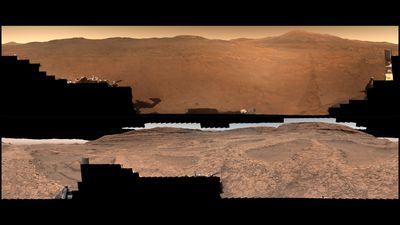
NASA has recently published two stunning panoramas from the two rovers. They reveal two very different environments around Mars and the focus of the respective rovers. While they are tasked similarly to study the geology of the Red Planet and look for evidence of life, their approaches are literally going in two different directions – especially in time.
The space agency jokes that they are both time-traveling but towards different epochs. Gale Crater ended up being a lake multiple times in its existence. Mount Sharp, now 5 kilometers (3 miles) above the crater floor, was formed from sediment layers deposited in those very lakes. As Curiosity climbs, it is encountering younger and younger terrains.
Perseverance, on the other hand, started inside Jezero Crater, looking at the delta structure created by an ancient river, and it’s now following the river to older and older terrain, actually exploring some regions that are among the oldest landscapes in the Solar System.
While both regions are several billion years old, this diametrically opposite approach is providing new insights into the geological history of Mars.
“The prospect of being one of the first humans to see pictures from another world filled me with awe. Yet every time we drive to a new location, that's exactly what our rover planners get to do; driving on Mars is truly a dream come true,” Mark Maimone, a long-time rover driver and mobility engineer at NASA's Jet Propulsion Laboratory, told IFLScience in a previous interview.
The Curiosity panorama was made by stitching together 1,031 images taken between November 9 and December 7, 2025. It produces a stunningly detailed view of the boxwork formation region. Also known as the Giant Spiderwebs, these structures are enormous compared to similar geological structures seen on Earth. They are believed to have formed as water flowed through cracks in the rock, leaving minerals behind and strengthening ridges.
The 360-degree panorama from Perseverance is outside of the rim of Jezero Crater, a place that has been nicknamed Lac de Charmes after a French artificial lake. Some of the distant mountains far away from the Jezero crater are visible. It is made of 980 images taken between December 18 last year and January 25, 2026.
The two rovers have achieved so much already, but the best may be yet to come!