Space and Physics
 PUBLISHED



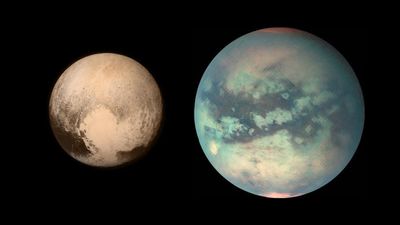


Titan and Pluto might seem to have little in common. The moon of Saturn is much larger than the dwarf planet. Titan has a thick atmosphere, while Pluto barely holds onto one. On top of that, Titan has lakes, rivers, and rain, whereas Pluto's surface is frozen.
But there is something they share. There is a mysterious substance on both their surfaces, and scientists aren't sure what it is.
The research team, led by Dr Bruno Bézard at the Paris Observatory, used the JWST to study Titan, hoping to penetrate the moon's thick atmosphere. What they found was a weak feature in the light spectrum; something on the surface was absorbing infrared light at a wavelength of 5.11 microns.
The question was whether this was an atmospheric feature or a rarer surface one. This is where Pluto comes in. JWST observations of the dwarf planet have also revealed the presence of a feature on its surface at the same wavelength.
“It's exciting because we have little information on the composition of the surface of the solid surface of Titan,” Bézard told IFLScience. “[The surface of Titan] is very difficult to access due to the opacity of the atmosphere, which has a lot of methane, which is opaque at many wavelengths in the infrared.”
“We suspect there is water ice; there are some organic particles that settle on the ground, but no clear identification of anything, in fact.”
We looked at many simple ices that could be present [...] and they don’t match.
Dr Bruno Bézard
Often enough, astronomers can use light spectra to figure out the chemical compounds present across the Universe. This is possible thanks to an extensive library of what the emission or absorption of known elements and molecules are, which can then be compared to the readings gathered from the telescopes. This is how we can find, for example, the presence of elements in some of the oldest known galaxies.
But we've not classified all the spectra of all the molecules in all conditions.
This is why the team can be moderately confident that they have found a surface feature, while at the same time not knowing exactly what they're looking at.
Despite being wildly different in density, the atmospheres of Titan and Pluto actually share similarities in composition. Molecules known as tholins, composed of carbon and nitrogen, are ubiquitous in Titan’s atmosphere, where they form through a process known as photochemistry.
The very same compound is thought to be responsible for the dark red patches on both Pluto and its moon Charon. On Charon, this feature is known as the Mordor Macula.
“We looked at many simple ices that could be present due to the condensation of all the hydrocarbons and nitrates, all the photochemical compounds that are formed in Titan's atmosphere, and they don’t match,” Bézard told IFLScience.
“There are a few compounds that are not too far, as well as a whole family of compounds that [could fit]; we call them allenes.”
Allenes can have slightly different physical structures, and the signal detection could be a particular mixture of allenes under certain conditions, each specific to the two worlds. Also, the feature on Pluto, while centered on the same wavelength as on Titan, is three times as broad. The two are related but might not be exactly the same, with different molecular structures, mixtures, or just states at the surface.
In 2028, NASA's Dragonfly mission will launch. Arriving on Titan in 2034, it will be a nuclear-powered flying vehicle that can move over the moon’s surface as it completes incredible science.
While it won't have an infrared spectrometer on board, meaning it won’t be able to match readings from the surface with the observed data from this study, it will have an instrument that will reveal compounds on the moon's surface. The team back on Earth will then have to work out which of them might have an absorption feature in the infrared that matches the JWST readings.
The team is not waiting for Dragonfly, though. They are collaborating with another group led by Jonathan Lunine on studying the distribution of this mysterious compound on the surface of Titan.
“It may be important. Maybe it will help us to see if it correlates with some geomorphological feature at the surface, like with the vast dune fields,” Bézard told IFLScience.
The chemistry of Titan is believed, by many, to be similar to the early chemistry of our own planet. Earth might have had carbon and nitrogen photochemistry before life took over and long before oxygen became so abundant.
Studying Titan with its lakes of methane, its rain and invisible rainbows, and with its currently unknown surface composition might provide us with a unique window into the distant past of our planet.
The study has been accepted by the journal Astronomy & Astrophysics and a preprint is available via ArXiv.