


 Nature
 PUBLISHED


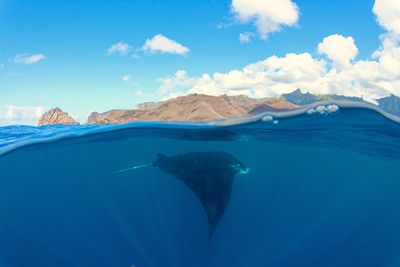


New species are all around us, and while some have been hiding away in the foliage of tropical forests, some have been hiding in plain sight. In 2009, one manta ray species was revealed to actually be two distinct species, and now, after 15 years of it being suspected, a third new species officially joins the party.
The new species has been named Mobula yarae after Yara, a water spirit from Indigenous Brazilian mythology. This new species only lives in Atlantic Ocean waters and joins the giant oceanic manta (Mobula birostris) and the reef manta (Mobula alfredi) as the third manta species on Earth.
This discovery is largely down to one individual. Dr Andrea Marshall, who is the co-founder of the Marine Megafauna Foundation, revolutionized manta ray science in 2009 by splitting the only known species of manta ray into two species. In that 2009 paper, Marshall predicted the existence of a third species that would exist in the Atlantic Ocean, and now comes the research to prove it.
Marshall had been hand-drawing the different manta ray species from her own underwater photographs. "It had taken me 6 years to differentiate the first two species, and I knew them inside out at this stage,” Marshall said in a statement. Then, when comparing them to other images, she knew she was looking at something different. "This manta didn't look like either of them."
Dr Marshall experienced a severe brain aneurysm in 2024 while working with international collaborators on a formal paper to confirm the new species. While she is on medical leave, the team completed the formal description, combining both genetic analysis and studying the morphology, confirming Marshall had been right all along.
In terms of appearance, the new species has “V” shaped white shoulder patches that are different from the “t” shaped patches seen in M. birostris. The species also has lighter colors around the face and eyes compared to the two other species and lacks spots on the underside that extend to between the gills.
M. Yarae can reach up to 5-6 meters (16-20 feet), similar to the giant oceanic manta, though some juveniles were observed at a more reef manta size of 3-4 meters.
Compared to the other two species, Mobula yarae is more likely to be found in coastal areas and in estuaries, which are different from the areas inhabited by Mobula birostris. The team hopes that recognising this new species will lead to conservation strategies on both an international and local level. The oceanic manta ray is currently classified as Endangered, while reef mantas are Vulnerable on the IUCN Red List, both with decreasing populations.
“The formal recognition of Mobula yarae is crucial for manta ray conservation efforts,” said co-author Jessica Pate, founder of the Marine Megafauna Foundation’s Florida Manta Project. “You can’t protect what you haven’t formally identified. Now that we’ve proven that this Atlantic manta ray is distinct, we can tailor our research and conservation initiatives to protect the species."
The paper is published in Environmental Biology of Fishes.


 1
1