Nature
 PUBLISHED


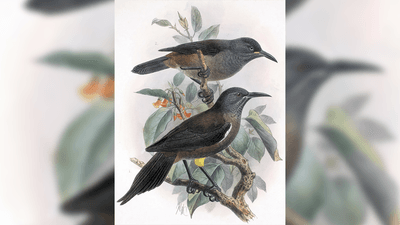


Stories of extinctions are always difficult to read. Species fall out of existence for a number of reasons, whether due to disease, loss of habitat, or direct actions by humans. The Kauaʻi ʻōʻō from Hawaii, though, is a particularly heartbreaking example.
The Kauaʻi ʻōʻō was the smallest of the five known species of Hawaiian honeyeaters, and lived on the Hawaiian island of Kauai. It was a small black bird measuring around 20 centimeters (8 inches) long, with a distinguishing feature: the bird possessed yellow feathers on its legs. As the name suggests, the species had a sweet tooth, primarily feeding on flowers using a specialized tongue and slightly downcurved bill to enable them to reach the nectar within.
Unfortunately, the combined threats of habitat loss, disease-carrying mosquitoes, and predation by invasive species like rats and pigs took a toll on the population. In particular, hurricanes that hit the island took out large trees with cavities that the Kauaʻi ʻōʻō used for nesting, as well as large areas of food-rich forest. As a result of the species’ decline, the bird was listed as endangered by the US Government in 1967.
Then, in 2000, the IUCN declared the species extinct, and in 2023, this finally resulted in Kauaʻi ʻōʻō being delisted from the US Endangered Species Act.
Details around when the bird was last seen and recorded before it was deemed to be extinct are hazy, but it is thought to have disappeared from sight and sound around the middle to end of the 1980s. However, the last sighting of this species is thought to have occurred in 1985.
It was a year after this sighting that ornithologist Jim Jacobi captured what could be the last ever recording of a Kauaʻi ʻōʻō call, taken in Alaka'i Swamp.
Tragically, the recording features only half of a song; there is no response for the Kauaʻi ʻōʻō in the tree. Kauaʻi ʻōʻō were very vocal birds who used their song both to call for a mate and to reach across distances in the dense forest. It’s even been suggested that the voice of the Kauaʻi ʻōʻō is the only song of the honeyeaters that has been heard by anyone now living, as recordings of the other species don't appear to have been taken or published.
Writing for The Conversation in 2022, Hannah Hunter – at the time a PhD candidate at Queen’s University in Kingston, Ontario, who was researching recorded sounds for species that are extinct, or may be extinct – quite aptly said of the recording: "We have no way of knowing if this was the very last bird, but it’s hard not to listen as if it were."