Nature
 PUBLISHED
 5
5


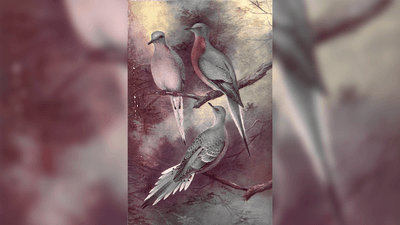


If you were to tell your great-great grandmother that you had never seen a live passenger pigeon – a true fact, assuming you’re less than 110 years old – she probably wouldn’t believe you.
“At the start of the nineteenth century these birds existed in unimaginable numbers – billions upon billions,” wrote Errol Fuller, an artist and author known for his books on extinction and extinct creatures, in 2014’s The Passenger Pigeon. “The species may have made up as much as 40 percent of the bird population of North America. It may even have been the most numerous bird species on the planet.”
Descriptions from the time report flocks so vast and dense that they could block out the sun; wings so numerous that their combined flapping sounded like an oncoming tornado. Children would scream and flee when they saw the birds approaching, says one 1855 account from Columbus, Ohio; adults dropped to their knees and prayed. Hours later, when the flock had finally passed over, “the town looked ghostly in the now-bright sunlight that illuminated a world plated with pigeon ejecta.”
A few decades later, though, the birds were nowhere to be seen. In 1900, the last recorded wild passenger pigeon was seen and shot in Ohio; in 1914, the last known individual of the species – a captive female, named Martha to match her onetime cage mate George – died at her home in the Cincinnati Zoological Garden. The passenger pigeon was officially extinct.
How the hell did it happen?
The rise and fall of a billion birds
For millennia, North America was pigeon country. The birds’ dominance of the continent stretched back way further than its colonization by Europeans: sites where their bones have been found “span periods from the late Pleistocene to the early nineteenth century,” wrote Joel Greenberg, a research associate of the Field Museum and the Peggy Notebaert Nature Museum in Chicago, in his 2014 book A Feathered River Across the Sky: The Passenger Pigeon's Flight to Extinction.
By around 700 CE, the birds were really hitting their stride. In one archaeological site from the period, in Tennessee, more than 1,000 passenger pigeon bones were found at once – potentially the first “clear evidence for the exploitation of roosting locations”, according to archaeologist H. Edwin Jackson.
Indigenous Americans almost universally lived by cultural and religious laws that acted as effective wildlife management policies: they would never kill nesting adults, for example; for the Seneca, trees hosting a “chief” bird could not be felled, and the Ho-Chunks would only hunt the birds for specific feasts; some tribes were known to enforce their laws on other hunters, so important was the passenger pigeon to their lives.
The result of these worldviews and policies was that, when Europeans reached the continent in the 15th (barely) and 16th (mostly) centuries, they were left agog at how many birds they could see. Over and over again, records from those earliest visitors and colonists make special mention of the seemingly infinite number of pigeons in the new land: the “wilde Pidgeons” were “beyond number or imagination,” wrote Ralph Hamor in around 1610; “my selfe have seene three or four houres together flockes in the Aire, so thicke that even they have shadowed the Skie from us.”
But as impressed as the Europeans were by the passenger pigeons, they had none of the respect for the birds that the Native Americans had shown. Instead of cultivating or protecting the vast forests that the birds needed to nest, the settlers cleared them to make way for farmland and homesteads. When the pigeons responded to the loss of resources by feeding on the farmers’ grain, they were shot.
After a few generations of increasing expansionism across the continent, a few people started to notice the declining numbers of passenger pigeons in places like Ohio and New York – but it was in the 1800s that the slaughter really began. Hunting of the birds ramped up to an industrial level: “The birds were shot at the nesting sites, young squabs were knocked out of nests with long sticks, and pots of burning sulphur were placed under the roosting trees so the fumes would daze the birds and they would fall to the ground,” notes the Smithsonian National Museum of Natural History (NMNH). “Hundreds of thousands of passenger pigeons were killed for private consumption and for sale on the market, where they often sold for as little as fifty cents a dozen.”
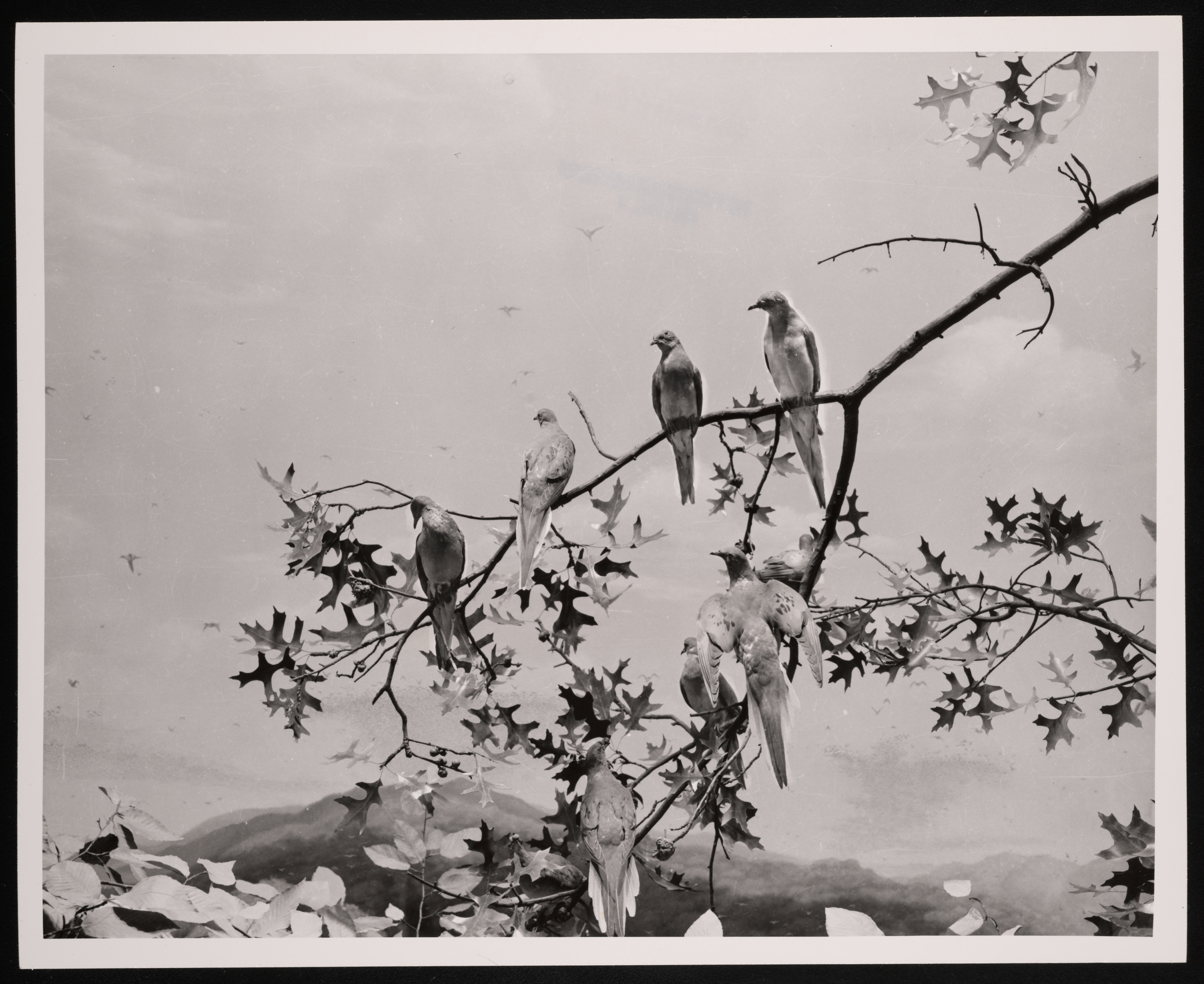
But the final nail in the coffin was probably the spread of railroads. The building of these inter-city links led to deforestation on a massive scale, explained David Steadman, Curator of Ornithology at the Florida Museum of Natural History, in 2017 – effectively destroying most of the habitat of the passenger pigeon. “And then the other thing is, market hunters would hunt the passenger pigeons in huge numbers,” Steadman added, “and pack the breasts of these pigeons – they only saved the breasts – they’d pack [them] in salt barrels, and they could get them to the major cities in the East within a day or two.”
With trains and telegraphs, killing the birds became a wholesale operation. Greenberg’s book describes the fate of one of the last great nesting colonies, in northern Michigan: once spotted, telegraph operators wired the birds’ location to hunters hundreds of miles away. Within a few days, so many of them had arrived that “hotels and boardinghouses ran out of space,” he wrote; more than a million birds were killed in the frenzy.
“There’s a very interesting account from a railroad guy – he ran the station in Sheffield, Pennsylvania – and in September of 1876 he counted 770,000 Passenger Pigeon breasts packed in barrels and then he gave up,” recalled Steadman. “He said, ‘All I know is I’m packing more than a million to go back to New York’.”
Even with a starting population as large as the passenger pigeons’ had once been, surviving such an onslaught was impossible. Over the course of mere decades, the species crumbled, and by the 1890s only a few straggling flocks, numbering in the dozens rather than the hundreds of millions, held on.
Twenty-five years after that, they were gone.
Over the tipping point
Booming numbers of humans in an area, as was seen in the US in the second half of the 19th century, rarely spells good news for the local wildlife. The country today has mere fractions of the once-abundant populations of deer, wolves, bears, beavers and suchlike that were seen by the first Americans; bison, famously, were all-but extinguished nationwide, leaving a comparatively tiny population today that has extremely low genetic diversity.
But all those species, as reduced as they were, still clung on to survival. So what set the passenger pigeon apart?
“The passenger pigeon's technique of survival had been based on mass tactics. There had been safety in its large flocks which often numbered hundreds of thousands of birds,” explains the NMNH. “When a flock of this size established itself in an area, the number of local animal predators (such as wolves, foxes, weasels, and hawks) was so small compared to the total number of birds that little damage could be inflicted on the flock as a whole.”
Unfortunately, the tactic that had made the passenger pigeon so successful before colonization and industrialization was exactly the thing that doomed it afterwards. When the vast forests that had once housed hundreds of millions of the roosting pigeons were gone, the birds didn’t simply switch to living in smaller flocks – they couldn’t, in fact. “The social behavior of these pigeons required they nest in big colonies,” Steadman explained – and outside of such huge groups, nesting and reproduction was impaired.
“It was the double whammy,” Stanley Temple, a professor emeritus of conservation at the University of Wisconsin, told the National Audubon Society in 2014. “It was the demographic nightmare of overkill and impaired reproduction.”
“If you’re killing a species far faster than they can reproduce, the end is a mathematical certainty.”
The new passenger pigeons
The decline and fall of the passenger pigeon didn’t surprise everyone. As early as the 1660s, John Josselyn noted that the species was “much diminished, the English taking them with nets”; a century later, in New York, ornithologist Ashton Blackburne wrote that “this spring […] every body was amazed how few there were; and wondered at the reason.”
But for most people, the idea that passenger pigeons could ever die out entirely was an impossibility. “Certainly if you read some of the writings of the time, there were very few people who put stock in the idea that humanity could have any impact on the passenger pigeons,” David Blockstein, senior scientist at the National Council for Science and the Environment, told Audubon.
And even as it became more obvious that the birds were in trouble, “there was virtually no effort to save them,” said Greenberg. In fact, people fought attempts to protect passenger pigeons: “The industry that paid people to kill these birds said, ‘If you restrict the killing, people will lose their jobs’,” he explained.
If either of those arguments sound familiar, they should. They’re “the very same things you hear today,” Greenberg said – but this time regarding climate change. Today’s arguments against acting to preserve the planet have striking echoes of those who chased the passenger pigeon into its coffin: people’s livelihoods depend on fossil fuels, after all – and how can you really expect us to believe humans are responsible anyway? “It’s the same kind of argument,” Blockstein said. “‘The world is so big and the atmosphere is so big; how could we possibly have an impact on the global climate?’”
For other species of animal and for the Earth itself, then, the fate of the passenger pigeon stands as a stark warning about the carelessness of humans towards nature. The same arguments rule, over and over again – but hopefully, when it comes to climate change, we’ll react better and faster than we did with the birds.
Passenger pigeons were once “the most beautiful flowers of the animal creation of North America,” according to Simon Pokagon, a writer and member of the Pokagon Band of Potawatomi Indians, in 1895.
“What,” he wondered, “must be the […] degree of punishment awaiting our white neighbors who have so wantonly butchered [them] and driven [them] from our forests [?]”